

When you request an LTL shipping quote, one of the first things a carrier or broker needs to know is your freight class. Get it right, and your rate matches your quote. Get it wrong, and a carrier inspection at the terminal can add reclassification fees, re-weigh charges, and a significantly higher invoice, usually discovered after the freight is already in the network. National carriers inspect 75 to 95 percent of shipments using automated dimensionalizers at their terminals. Regional carriers run closer to 50 percent. The technology investment is significant — Old Dominion, for example, operates multiple dimensionalizers at a single terminal location. Getting caught is not the exception.
Freight class is the system LTL carriers use to standardize pricing across tens of thousands of different commodities. It is based on how difficult your freight is to transport, not just how heavy it is. A pallet of foam pillows and a pallet of steel bar stock can weigh the same but move at completely different rates because they occupy space and pose risk very differently.
This guide explains exactly how LTL freight classification works: the four factors that determine your class, the full 18-class NMFC table, how to calculate your freight density, and what it costs you when the class is wrong.
LTL freight class is a number from 50 to 500 assigned to your shipment based on density, stowability, handling difficulty, and liability. Lower class means denser, easier freight and a cheaper rate. Higher class means lighter, bulkier, or more fragile freight and a more expensive rate. The most common mistake shippers make is guessing their class, which triggers re-weigh and reclassification fees at the terminal.
What Is LTL Freight Class?
Freight class is a standardized pricing category established by the National Motor Freight Traffic Association (NMFTA) through the National Motor Freight Classification (NMFC) system. It assigns every type of commodity a class number between 50 and 500, which LTL carriers use to set rate multipliers on their pricing tariffs.
The system exists because not all freight is equally easy or cheap to haul. A carrier loading a trailer needs to account for how much space the freight takes up, how safely it can be stacked alongside other shipments, how likely it is to be damaged or cause damage, and what the financial exposure looks like if something goes wrong. Freight class is the standardized answer to all of those questions, expressed as a single number that translates directly into a rate multiplier.
There are 18 freight classes in the NMFC system, ranging from Class 50 (densest, most efficient to ship, lowest cost) to Class 500 (lightest, lowest density, most expensive per pound to move).
The 4 Factors That Determine LTL Freight Class
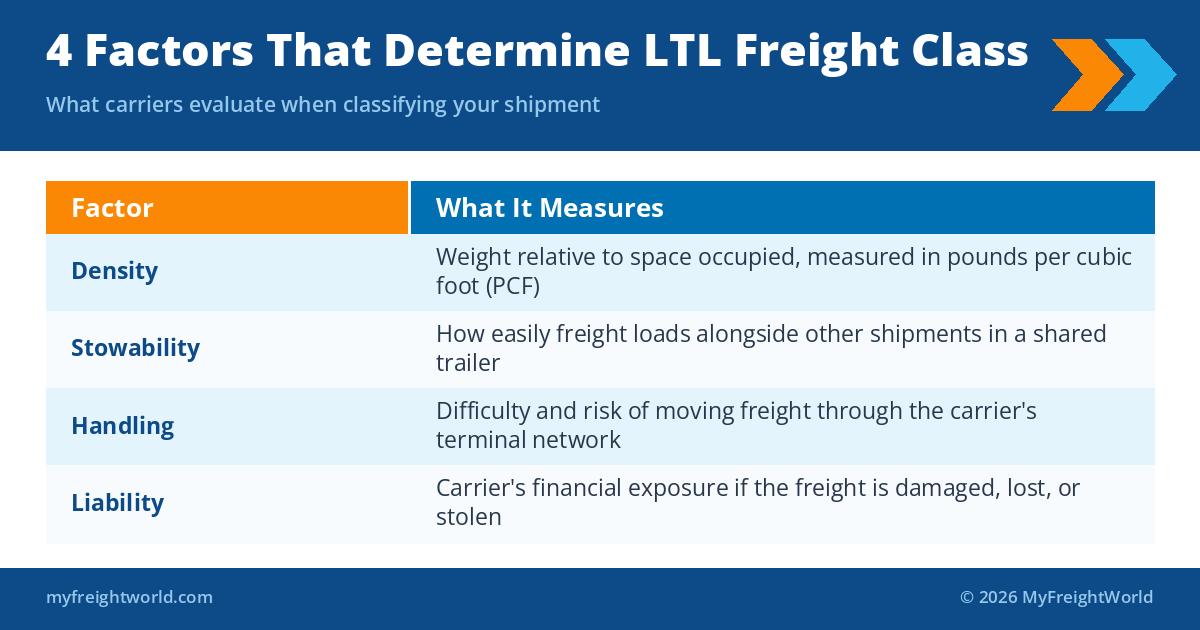
Every freight class assignment is based on four characteristics. Density is the most influential for the majority of standard commodities, but all four factors matter, and some product categories are class-assigned primarily by NMFC code rather than density calculation.
1. Density
Density is the weight of your freight relative to the space it occupies, measured in pounds per cubic foot (PCF). Higher density means your freight is compact and fills trailer space efficiently. Carriers can stack more, earn more per linear foot, and take on less risk. High-density freight gets lower class numbers. Low-density freight gets higher class numbers.
2. Stowability
Stowability describes how easily your freight can be loaded alongside other shipments. Standard rectangular pallets with stable stacking height are easy to stow. Freight that is irregularly shaped, oversized, hazardous, or cannot be stacked is harder to position in a shared trailer, which means less efficient use of space and a higher class assignment.
3. Handling
Handling accounts for how much effort and care it takes to move your freight through the carrier’s terminal network. A standard palletized shipment moves easily with a forklift. Freight that requires special equipment, is fragile, is an unusual shape, or poses a safety risk to handlers is rated at a higher class to offset the additional labor and attention required.
4. Liability
Liability reflects the carrier’s financial exposure if something goes wrong: damage, theft, or loss. High-value commodities, perishables, and freight that could cause damage to other shipments in the trailer carry higher liability. That exposure is factored into the class assignment, which is why high-value electronics or fragile goods typically move at higher class numbers than dense industrial freight.
LTL Freight Class Chart: All 18 NMFC Classes
The table below covers all 18 NMFC freight classes with typical density ranges and commodity examples. Use it as a starting point. Your exact class should always be confirmed against your NMFC code and actual shipment density before you quote.
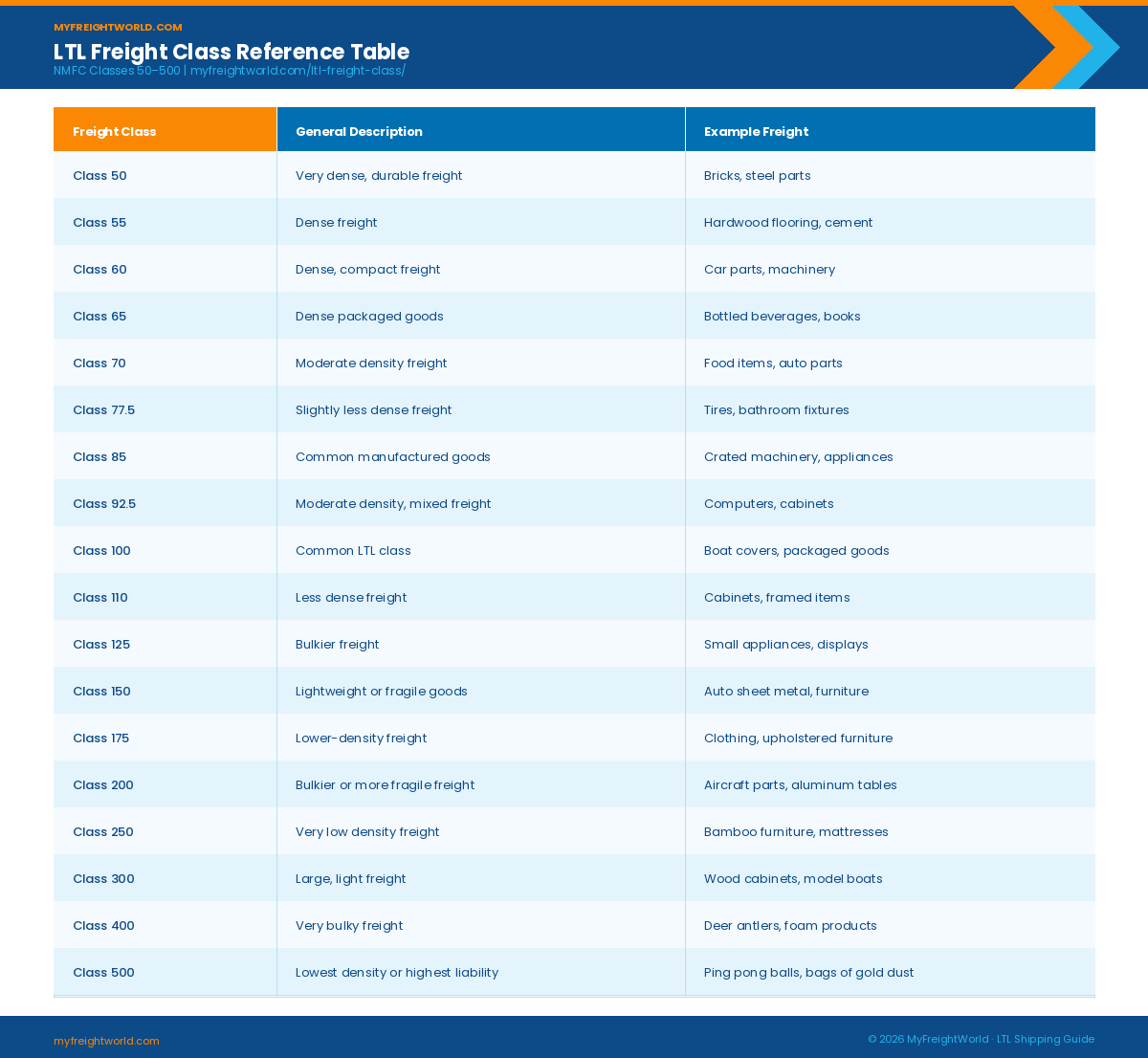
Note: Classes 50 and 55 represent the most cost-efficient freight categories. Most standard industrial and consumer goods shipments fall between Class 65 and Class 150.
This table gives you the density-based starting point, but the precise class for your commodity is determined by its NMFC code. Some items have density-based class assignments; others have a fixed class regardless of density. For a full NMFC codes and freight class lookup, see our complete guide.
How to Calculate LTL Freight Density
Density is the most commonly used factor to determine freight class for standard commodities. The calculation is straightforward. You need the weight of your shipment and its physical dimensions.
Volume (ft3) = [Length (in) x Width (in) x Height (in)] / 1,728
Always measure the actual dimensions of the loaded pallet, including any overhang, dunnage, or protective packaging, not just the product itself. Carriers measure the full footprint when they inspect freight at the terminal.
Step 1 – Dimensions: 48 in (L) x 40 in (W) x 48 in (H)
Step 2 – Volume: 48 x 40 x 48 = 92,160 cubic inches / 1,728 = 53.33 cubic feet
Step 3 – Density: 200 lbs / 53.33 ft3 = 3.75 lbs/ft3
Result: 3.75 PCF falls in the Class 300 range (2-4 lbs/ft3)

How to Find Your NMFC Code
Every commodity shipped via LTL has an NMFC code, a specific identifier in the National Motor Freight Classification system that ties your product to its class assignment. NMFC codes and freight class are related but not the same thing. The code identifies the commodity; the class derived from the code and your shipment’s density is what drives the rate.
To find your NMFC code, you can search the NMFTA’s published classification guide, ask your freight broker to look it up, or check with the carrier at the time of quote. Many shippers make the mistake of reusing the code from a previous shipment without verifying it still applies, especially if the product, packaging, or density has changed.
For a detailed breakdown of how NMFC codes work and how to find yours, see our guide to NMFC codes and freight class lookup. It covers the code structure, how to cross-reference density, and what to do when your commodity straddles two classes.

Common LTL Freight Class Mistakes
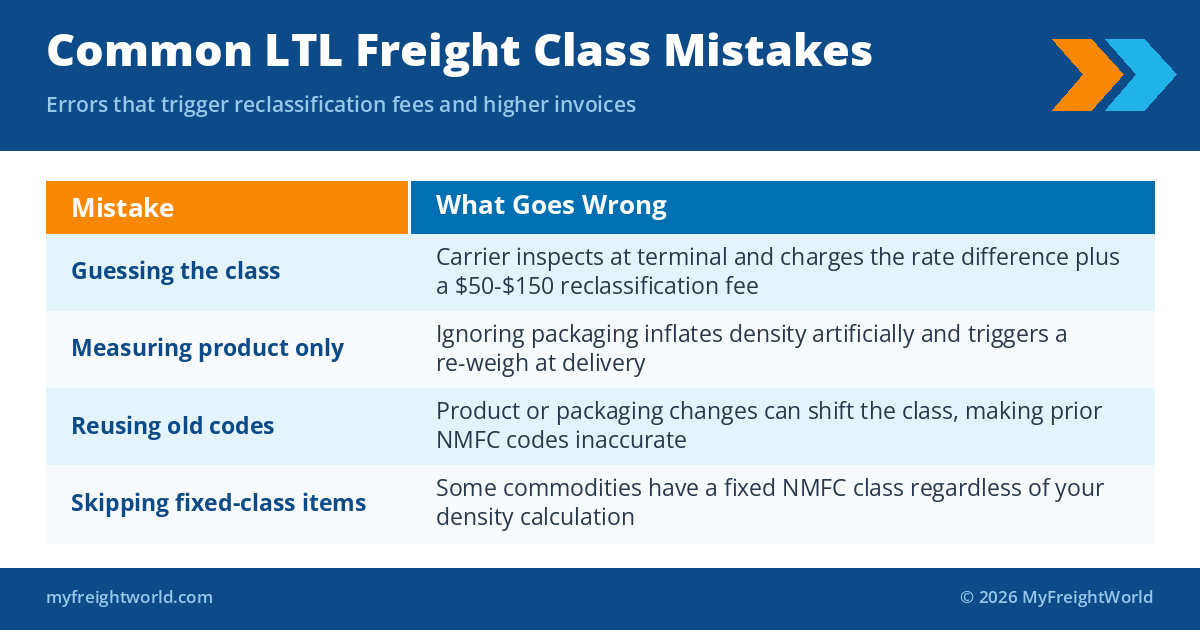
Most freight class errors fall into a handful of predictable patterns. These are the ones that show up on invoices most often.
Guessing the Class Instead of Calculating
This is the single most common mistake. Shippers who do not know their NMFC code estimate their class based on what seems right. If the estimate is too low, the carrier will reclassify the shipment at the terminal and charge the difference in freight rates plus a reclassification fee, often $75-$150 per shipment on top of the rate adjustment.
Measuring the Product, Not the Pallet
Freight class density is based on the full pallet as it ships, including packaging, dunnage, corner boards, and any overhang. Measuring only the product and ignoring packaging consistently underestimates volume, artificially inflates your calculated density, and suggests a lower class than the carrier will assign on inspection.
Reusing a Code from a Previous Shipment
If your product, packaging method, or pallet configuration has changed, the class from your last shipment may no longer apply. Always re-verify when anything about the freight profile changes, especially after product packaging updates or new SKUs are introduced.
Ignoring Fixed-Class Commodities
Some commodities have a fixed NMFC class regardless of their calculated density. If your product falls into one of these categories and you use a density-based class instead, you will be misclassifying every shipment. When in doubt, cross-reference the NMFC code. Do not assume the density formula alone determines the class.
How LTL Freight Class Affects Your Rate
Freight class is one of the primary inputs into the LTL rate calculation. For a complete look at all the factors that shape what you pay, see our guide to LTL shipping costs. Carriers apply a class multiplier to their base tariff rate, and the difference between adjacent classes can be significant. Moving from Class 100 to Class 150 on the same lane and weight can increase your linehaul rate by 30-60% depending on the carrier and tariff structure.
These are illustrative multipliers. Actual tariff rates vary by carrier and lane. The key takeaway is that a one- or two-class error on a 500-lb shipment can add $50-$200 to your quote before accessorials or fuel surcharge. Over a full year of recurring shipments, systematic misclassification adds up quickly.

The best way to ensure your class is right before booking is to calculate your density, cross-reference the NMFC code, and when in doubt ask your freight broker to verify before the quote is submitted.
Not Sure What Class Your Freight Is?
MFW will classify your shipment correctly before the quote goes out. No surprise reclassification fees.
Get an LTL Quote from MyFreightWorldFrequently Asked Questions: LTL Freight Class
What is the most common LTL freight class?
Most standard palletized industrial and consumer goods ship between Class 65 and Class 150. Class 70 and Class 100 are among the most frequently used for general merchandise. The exact class depends on your commodity’s density, stowability, and NMFC code. There is no universal default class that fits all freight.
What happens if I list the wrong freight class?
If the carrier inspects your freight at a terminal and determines the listed class is incorrect, they will reclassify the shipment and charge the difference in freight rates plus a reclassification or re-weigh fee, typically $50-$150 per occurrence on top of the rate adjustment. On larger or higher-class shipments this can add hundreds of dollars to your final invoice.
How do I determine my LTL freight class?
Start by calculating your freight density: measure the full packed pallet (length x width x height in inches, divide by 1,728 to get cubic feet), then divide weight in pounds by cubic feet to get your PCF density. Cross-reference that density against the NMFC freight class chart to find your starting class, then confirm against your commodity’s NMFC code since some items have fixed class assignments that override density.
Does freight class affect transit time?
Not directly. Freight class affects your rate, not how fast your shipment moves through the carrier network. Transit time is determined by your lane, carrier network density, pickup day, and whether an appointment or liftgate is required at delivery. A Class 500 shipment and a Class 50 shipment on the same lane will have similar transit times. The Class 500 will just cost significantly more per pound.
What is the difference between freight class and NMFC code?
Your NMFC code identifies the specific commodity you are shipping within the National Motor Freight Classification system. Your freight class (50-500) is the pricing category derived from that code, either based on your shipment’s density or assigned as a fixed class for that commodity type. Think of the NMFC code as the item ID and the freight class as the price tier.
Get Your Freight Class Right Before You Quote
LTL freight classification is not complicated once you understand the logic, but the cost of getting it wrong adds up fast. Every reclassification fee, every rate adjustment at the terminal, and every surprise on the final invoice traces back to a class that was not verified before booking.
The process is straightforward: measure your full loaded pallet, calculate density using the PCF formula, find your NMFC code, and confirm the class before submitting your quote. If you are unsure where your freight lands, a freight broker can verify it for you and make sure the quote you receive is the rate you will actually pay.
For the bigger picture on how freight class fits into your overall LTL rate, alongside fuel surcharge, accessorials, and carrier selection, see the complete LTL shipping guide.
Ready to Ship?
Get an LTL quote from MyFreightWorld. We will verify your freight class and make sure your rate is accurate from the start.
Get an LTL Quote — MyFreightWorld