

The 53-foot dry van is the standard trailer for truckload freight in North America, so knowing exactly what fits inside one is the foundation of good load planning. Get the capacity right and you avoid rejected loads, re quotes, and paying for space you cannot use. This guide lays out the dimensions, pallet counts, and weight limits, and what to do when your freight exceeds them.
For the broader equipment picture, see our dry van shipping guide, and start at the truckload freight hub for the full mode overview.
A 53-foot dry van holds about 26 standard pallets in one layer (up to 52 double stacked), carries roughly 44,000 to 45,000 pounds, and offers about 3,800 to 4,000 cubic feet. Most loads hit the weight limit before they run out of space. Freight beyond these limits needs flatbed, partial, or oversized handling.
53-Foot Trailer Dimensions and Capacity
Here are the standard interior dimensions and limits for a 53-foot dry van. Actual figures vary slightly by trailer make and model.
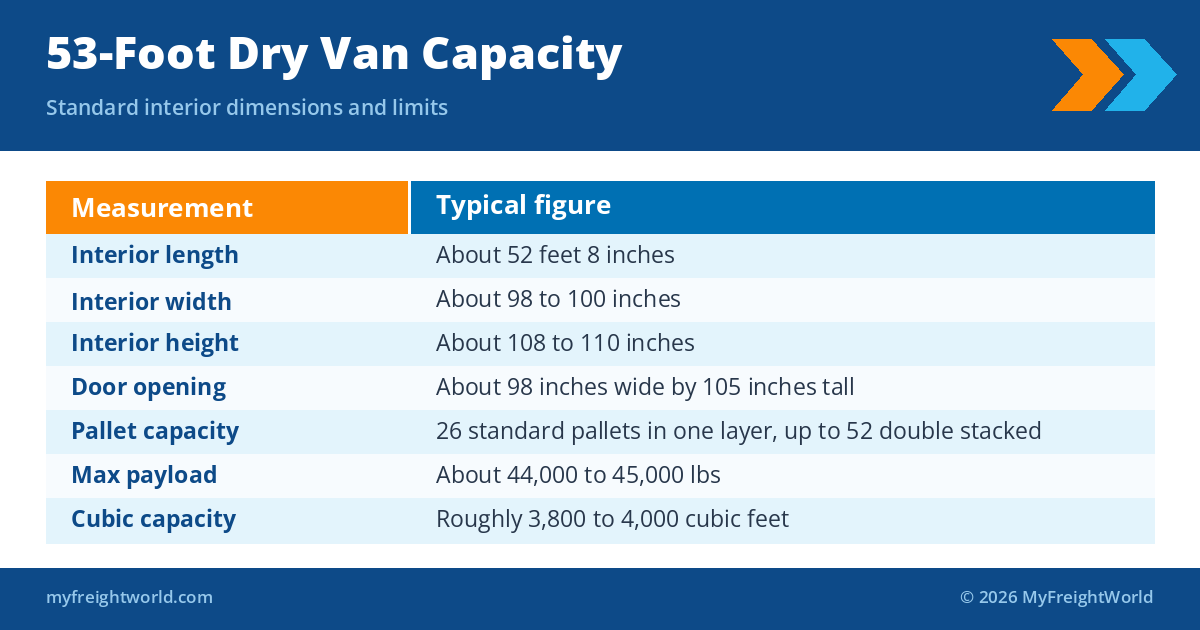
These numbers are the planning baseline. The interior length of about 52 feet 8 inches and width near 100 inches are what determine how your pallets lay out.
How Many Pallets Fit in a 53-Foot Trailer?
A 53-foot trailer fits 26 standard 48 by 40 inch pallets in a single layer, loaded straight in two rows of 13. If the freight is stackable, you can roughly double that to about 52 pallets. Turning pallets or using 48 by 48 footprints changes the count, so confirm your pallet size when you plan.
Weight Out vs Cube Out
Two things limit a load: weight and space. Dense freight weights out, it hits the roughly 45,000 pound payload cap before the trailer is full. Light, bulky freight cubes out, it fills the space before reaching the weight limit. Knowing which one you hit first helps you decide between a full truckload and a partial.
When Your Freight Exceeds a 53-Foot Trailer
If your freight is taller, wider, or heavier than a dry van allows, you need different equipment. Open deck or oversized loads move on a flatbed. A load too big for LTL but that will not fill a van may fit partial truckload. And if you are weighing a full trailer against a smaller mode, our FTL vs LTL guide shows where the line is.
Planning a truckload?
Tell us your weight and pallet count and we will confirm the right equipment and a competitive rate.
Request an FTL QuoteFrequently Asked Questions
How many pallets fit in a 53-foot trailer?
About 26 standard 48 by 40 inch pallets in a single layer, or up to 52 if they can be safely double stacked. Pallet size and orientation change the count.
What is the maximum weight for a 53-foot trailer?
A 53-foot dry van carries about 44,000 to 45,000 pounds of payload, depending on the tractor and trailer weight and legal axle limits.
What are the interior dimensions of a 53-foot trailer?
Roughly 52 feet 8 inches long, 98 to 100 inches wide, and 108 to 110 inches tall, for about 3,800 to 4,000 cubic feet of space.
What if my freight is too big for a 53-foot trailer?
Oversized or open deck freight moves on a flatbed or step deck. Loads too large for LTL but smaller than a full trailer can move as partial truckload.
Plan Your Load With MFW
Knowing your trailer capacity is the first step to a clean, well priced truckload. MyFreightWorld helps you match freight to the right equipment every time. Visit the truckload freight hub or request a quote to get started.
Ready to book a truckload?
Send your weight and pallet count and we will confirm the right trailer and a competitive rate, usually the same day.
Request an FTL Quote