

Truckload freight shipping moves a full trailer load for a single shipper, directly from pickup to delivery. The process is simpler than it looks once you see the steps and the people involved. This guide walks through how a truckload shipment actually moves, from the first quote to the proof of delivery.
If you are new to the mode itself, start with our explainer on what full truckload shipping is, then come back here for the process.
A truckload shipment follows five steps: quote and tender, carrier match, dispatch and pickup, direct in transit movement with tracking, and delivery with proof of delivery. A broker coordinates the carrier, the driver, and the tracking so the shipper has a single point of contact.
The Truckload Shipping Process, Step by Step
Every truckload move follows the same basic path from quote to delivery.
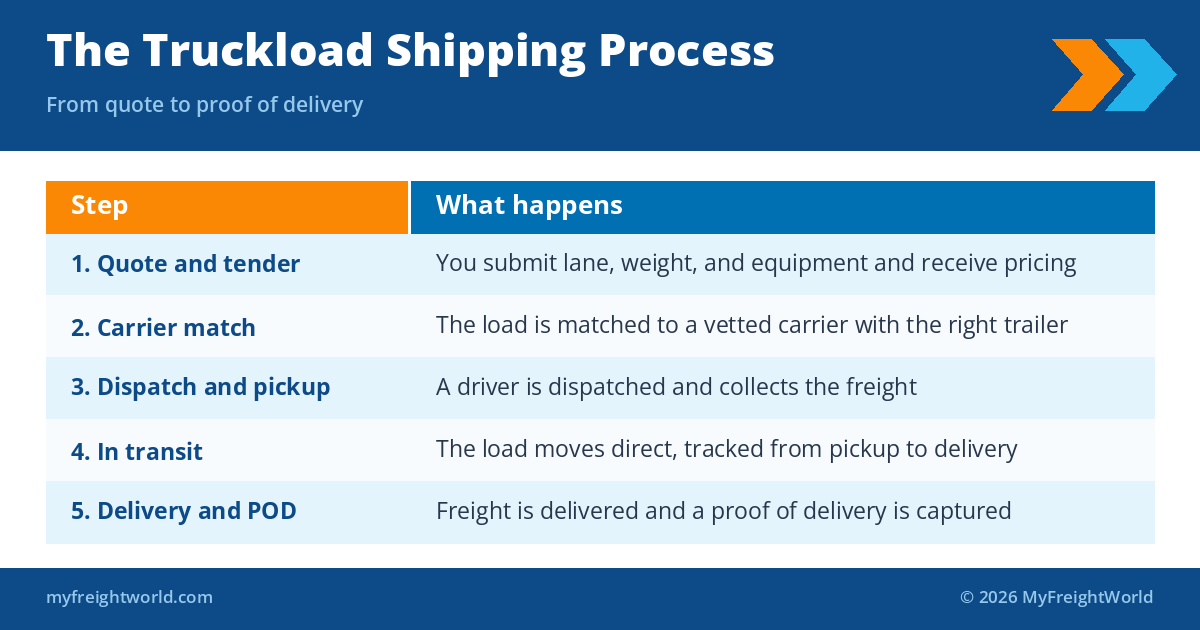
The key thing that makes truckload faster than shared modes is step four: the trailer goes direct, with no terminal transfers or cross docking along the way. Your freight is loaded once and delivered once.
Who Is Involved
Four players move a truckload shipment: the shipper who tenders the freight, the carrier that owns the truck, the driver who hauls it, and often a broker that matches the load to a vetted carrier and coordinates the move. Our truckload carrier guide covers how carriers are vetted before they ever touch your freight.
Equipment and Tracking
The right trailer is matched to the freight at the quote stage, dry van for most loads, reefer for temperature control, flatbed for open deck. Once dispatched, modern truckload shipments are tracked from pickup to delivery, so you always know where the freight is and when it will arrive.
How Long It Takes
Because truckload moves direct, transit is faster and more predictable than LTL. Typical transit runs roughly 500 to 600 miles per day, with expedited options for tighter timelines. Lane, hours of service rules, and pickup timing all factor in. For how the cost is built across that distance, see our guide to full truckload rates.
Ready to move a truckload?
Send your pickup, delivery, weight, and equipment and we will handle the rest, from carrier match to delivery.
Request an FTL QuoteFrequently Asked Questions
How long does a truckload shipment take?
Truckload moves direct, so transit is faster than LTL, typically around 500 to 600 miles per day. The exact time depends on the lane, pickup timing, and driver hours of service rules.
Who handles the carrier and tracking?
When you ship through a broker, the broker matches the load to a vetted carrier, dispatches the driver, and provides tracking, so you have a single point of contact from pickup to delivery.
What is a proof of delivery?
A proof of delivery, or POD, is the signed document confirming the freight was delivered. It records the delivery time and condition and closes out the shipment.
Can I track a truckload shipment in real time?
Yes. Modern truckload shipments are tracked from pickup to delivery, so you can see the load’s location and estimated arrival throughout transit.
Ship Your Truckload With MFW
Truckload shipping is straightforward when an experienced partner runs the process. MyFreightWorld handles the carrier match, dispatch, and tracking on every load. Explore the truckload freight hub or request a quote to get moving.
Have a full load to move?
Tell us your lane and freight and we will match vetted capacity and competitive pricing, usually the same day.
Request an FTL Quote