
LTL shipping costs are not a single number. They are the product of six overlapping variables that interact differently on every shipment. The same pallet moved 500 miles can cost $150 on one carrier and $220 on another, depending on freight class, lane coverage, and how the accessorials stack up.
This guide breaks down exactly what drives your LTL rate, how to estimate your cost before you book, and the most effective ways to reduce what you spend without sacrificing service quality. New to LTL shipping? Our LTL shipping guide covers the full picture.
LTL shipping costs are determined by freight class, billable weight, lane, fuel surcharge, accessorial fees, and the carrier’s base tariff. Average rates range from $50 for a light regional shipment to $500 or more for a heavy, high-class, cross-country load with accessorials. The biggest levers for reducing cost are knowing your freight class, declaring accessorials upfront, and comparing rates across multiple carriers.
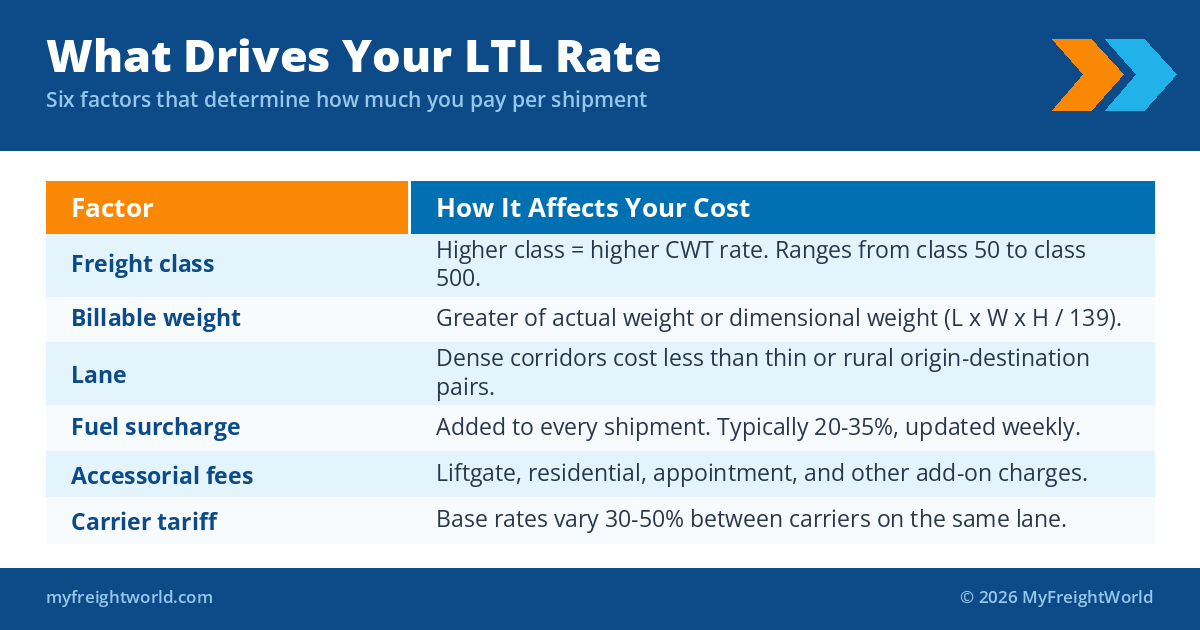
The Six Factors That Determine Your LTL Rate
Every LTL quote starts with a base rate from the carrier’s tariff, then applies adjustments for the variables below. Understanding each one helps you anticipate your actual cost before the invoice arrives.
Freight Class
Freight class is the single biggest variable in LTL pricing. The National Motor Freight Classification (NMFC) system assigns every commodity a class from 50 to 500 based on density, stowability, handling difficulty, and liability. Class 50 (the densest, easiest-to-handle freight) carries the lowest rate per hundredweight. Class 500 (the lightest, most fragile freight) carries the highest. The difference between a class 50 and class 100 shipment of identical weight can easily be 40 to 60 percent in rate. See our LTL freight class guide for a full breakdown of how to determine your class.
Billable Weight
Carriers charge based on billable weight, which is the greater of the actual scale weight or the dimensional weight. Dimensional weight accounts for the space a shipment occupies relative to its actual weight. If your pallet is physically light but takes up significant trailer space, the carrier may bill on dimensional weight rather than actual weight. Measuring every shipment accurately before booking prevents unexpected invoice adjustments.
Lane
The origin-destination pair affects pricing significantly. Carriers have dense coverage on high-volume corridors, such as Chicago to Atlanta or Los Angeles to Dallas, and those lanes carry competitive rates. Thinner lanes, rural origins, or destinations in carrier blind spots carry higher base rates because the carrier may need to interline the freight to a partner network to complete delivery.
Fuel Surcharge
Every LTL shipment carries a fuel surcharge, calculated as a percentage of the base linehaul rate. Carriers set their own fuel surcharge schedules, so the rate varies by carrier. Most update their surcharge weekly, tied to the EIA diesel price index published by the U.S. Energy Information Administration. The surcharge is not optional or negotiable, it is applied uniformly across all shipments, and it is one of the reasons the same load can price differently across carriers even when the base rate looks similar.
Accessorial Fees
Accessorial fees are add-on charges triggered by specific conditions at pickup or delivery. Common accessorials include liftgate service, residential delivery, limited access delivery, inside delivery, and delivery appointment requirements. Each adds $50 to $300 depending on the service. Accessorials declared upfront at quote time are priced at the carrier’s standard rate. Accessorials discovered at delivery are often charged at a higher corrective rate and cannot be disputed. For a complete list with typical cost ranges, see our LTL accessorial charges guide.
Carrier Tariff
Every carrier publishes a base rate tariff, and those tariffs vary significantly between providers. Two carriers quoting the same lane, class, and weight can come back 30 to 50 percent apart. This is why comparing rates across multiple carriers on every shipment is one of the most reliable ways to reduce LTL spend, particularly on lanes where you do not have a negotiated contract.
How to Estimate Your LTL Cost Before Booking
A rough LTL rate calculation follows this sequence: determine your freight class, calculate your billable weight (actual vs dimensional), identify your origin and destination zip codes, and note any accessorials that apply. With those four inputs, any carrier’s online quoting tool or a freight broker‘s TMS can return a rate in seconds.
As a general benchmark, regional LTL shipments (under 500 miles) typically run $0.15 to $0.35 per pound for standard freight classes. Long-haul shipments (over 1,500 miles) run $0.25 to $0.55 per pound before fuel surcharge and accessorials. Heavy, dense freight at class 50 to 70 sits at the low end; light, high-class freight at class 150 or above sits well above these ranges.
These benchmark rates are illustrative only. Actual rates depend on your specific carrier contracts, lane, class, and current market conditions. Always get a live quote before committing to a price with a customer or vendor.
Why Your Invoice Is Higher Than Your Quote
Invoice surprises are one of the most common complaints in LTL shipping. The gap between the quoted rate and the final invoice almost always traces to one of three sources: a weight or dimension discrepancy, an undisclosed accessorial, or a freight class dispute.
Weight and dimension discrepancies occur when the carrier’s dock reweigh or re-measurement produces a different number than what was declared at booking. Carriers charge based on their measurement, not the shipper’s. The best defense is to weigh and measure every shipment on a calibrated scale before tendering and document it with a photograph.
Undisclosed accessorials are the most avoidable source of billing disputes. If the delivery address is residential, if a liftgate is needed, or if an appointment is required, declare it when you book. The carrier will add those services at delivery regardless, and the corrective rate charged after the fact is typically higher than the rate quoted upfront.
Freight class disputes happen when the carrier’s inspector reclassifies your commodity at a higher class than declared. This triggers a reclassification fee plus the rate difference. Using the correct NMFC code, providing density calculations, and working with a broker who can push back on questionable reclassifications all reduce this risk.
Six Ways to Reduce Your LTL Shipping Costs
Most shippers have meaningful room to reduce their LTL spend without changing their service requirements. The tactics below address the most common sources of overpaying.

The two highest-impact tactics are knowing your freight class and comparing carrier rates. A shipper who fixes a freight class error saves on every shipment going forward. A shipper who starts comparing three carriers instead of defaulting to one often finds rate variance of 20 to 40 percent on the same lane with no service difference.
REDUCE YOUR LTL SPEND
We compare rates across multiple vetted carriers on every load. Most customers save 15 to 30 percent versus booking direct.
Get a Free QuoteFrequently Asked Questions
What is the average cost of LTL shipping?
LTL shipping costs vary widely depending on freight class, weight, lane, and accessorials. A light regional shipment might cost $80 to $150. A heavier cross-country shipment with multiple accessorials can run $400 to $800 or more. The best approach is to get a live quote with your specific shipment details rather than relying on averages.
How is LTL freight priced?
LTL freight is priced per hundredweight (CWT) based on a base rate from the carrier’s tariff, adjusted for freight class, billable weight, and lane. A fuel surcharge of 20 to 35 percent is added to every shipment, followed by any applicable accessorial fees. The final invoice reflects all of these components.
Why does LTL cost more per pound than truckload?
LTL freight goes through multiple terminals and is handled 4 to 6 times between pickup and delivery. The carrier’s cost to move a small shipment includes a proportional share of terminal operations, local pickup, linehaul, and local delivery, all for a small fraction of a trailer. That overhead is why LTL costs more per pound than a direct truckload move at higher weights.
What is a fuel surcharge in LTL shipping?
A fuel surcharge is a percentage added to the base linehaul rate to account for diesel fuel costs. It is updated weekly by most carriers based on the Department of Energy national diesel price index. Current LTL fuel surcharges typically run 20 to 35 percent of the base rate.
Can I negotiate LTL rates?
Yes. Shippers with consistent volume on specific lanes can negotiate contract rates with carriers, typically at a percentage discount off the carrier’s published tariff. A freight broker can also negotiate on your behalf and apply volume discounts from their carrier relationships to your shipments, even if your individual volume is relatively low.
What is a reweigh fee in LTL shipping?
A reweigh fee is charged when the carrier’s dock scales produce a weight that differs from what the shipper declared on the bill of lading. The carrier adjusts the rate to reflect the actual measured weight and adds a reweigh fee, typically $50 to $100. The best way to avoid this is to weigh every shipment on a calibrated scale before tendering and document it.
Getting LTL Costs Under Control
LTL shipping costs are controllable once you understand what drives them. The shippers who consistently pay less are not the ones with the lowest freight class or the best lanes. They are the ones who know their numbers, declare everything accurately upfront, and compare rates every time instead of defaulting to a single carrier.
A freight broker who works across multiple LTL carriers can eliminate most of the guesswork. You get competitive rates, consistent billing, and someone who knows how to push back when an invoice does not match the quote.
LTL RATE COMPARISON
Tell us your lane and load details. We will return rates from multiple carriers so you can see exactly what the market looks like.
Get a Free Quote