

Not all LTL carriers are created equal. The carrier you choose affects your transit time, your claims rate, your tracking visibility, and ultimately your freight costs. With dozens of options in the market, the question is not just who is cheap. It is who is right for your lanes, your freight type, and your service expectations.
This guide breaks down the top LTL carriers operating in 2026, what each one does best, and how to match a carrier to your actual shipping profile. Whether you are moving out of Kansas City or building a national shipping program, the right carrier starts with the right information. Our LTL shipping guide covers how the network works end-to-end.
The best LTL carrier depends on your lanes, freight type, and service requirements. Old Dominion leads on reliability and claims, FedEx Freight dominates on national coverage, and regional carriers like Saia and R+L often beat nationals on price within their footprint. A freight broker can qualify multiple carriers against your specific lanes so you are not guessing.
What Makes a Great LTL Carrier
Before ranking carriers, it helps to know what you are actually evaluating. The metrics that matter most in LTL are on-time delivery rate, claims ratio (how often freight arrives damaged), transit time for your specific lanes, and accessorial transparency. A carrier that posts great national averages but has weak coverage in your region is not a good choice for your operation.
You also want to consider technology. Can the carrier provide real-time tracking, electronic BOL, and EDI or API integration with your TMS? For high-volume shippers, that stack matters as much as the truck itself.
Top LTL Carriers in 2026
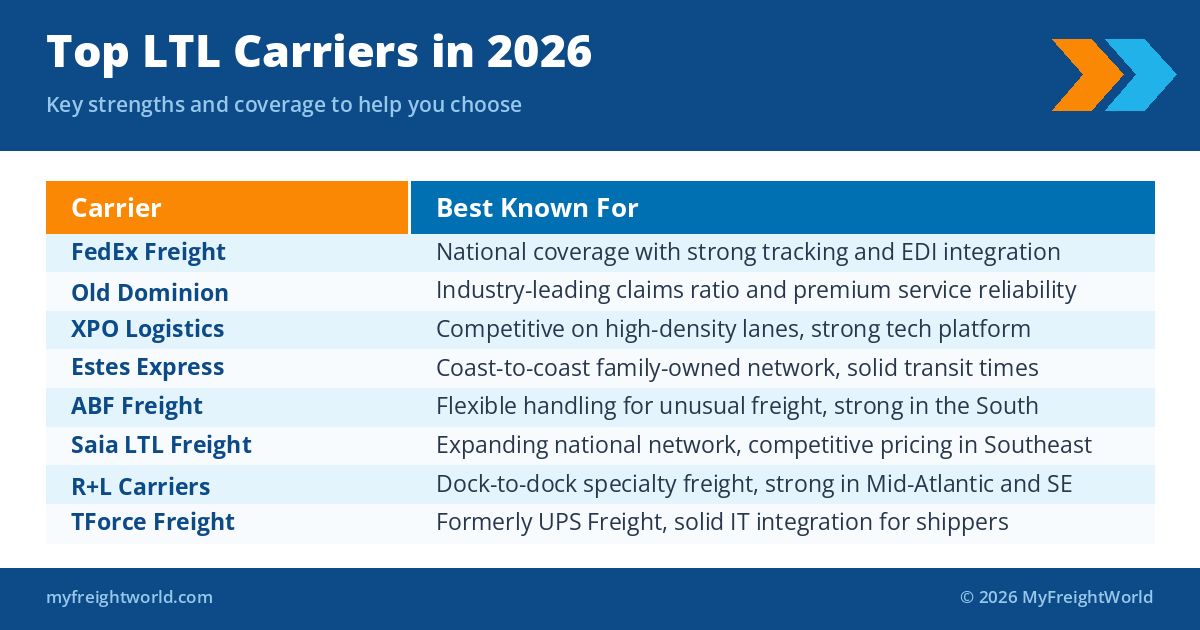
Here is how the major players stack up across the key factors shippers care about:
Old Dominion Freight Line
Old Dominion consistently ranks at the top of industry surveys for on-time performance and claims ratio. Their network is dense in the Southeast and expanding nationally. If your priority is reliability over price, Old Dominion is the benchmark carrier. Their online tools and PRO tracking are among the best in the industry.
FedEx Freight
FedEx Freight offers two service tiers, Priority and Economy, giving shippers flexibility on cost versus speed. Their national footprint is hard to beat, and their integration with the FedEx technology ecosystem makes them a strong fit for shippers who already use FedEx for parcel. Tracking is real-time and EDI integration is well-documented.
XPO Logistics
XPO is one of the largest LTL networks in North America. Their technology investment is significant, with a proprietary load optimization platform and robust API access for shippers. XPO tends to be most competitive on high-density lanes where their network can consolidate freight efficiently. Service consistency has improved since their spin-off restructuring.
Estes Express Lines
Estes is the largest privately owned LTL carrier in the U.S., which means less corporate overhead and more consistent service culture. Their coast-to-coast coverage is solid, and they are known for competitive transit times in the mid-Atlantic and Southeast. Estes handles a wide variety of freight types, including high-value and time-sensitive shipments.
Saia LTL Freight
Saia has been aggressively expanding through the acquisition of former Yellow Freight terminals, making them one of the largest capital investors in the post-Yellow market. That capacity buildout puts them in high-growth mode: they need to fill those terminals, which means pricing is competitive right now as they chase volume. Saia is a strong option for shippers looking to diversify away from the big nationals, and their current sell mode makes the timing favorable for shippers willing to qualify them.
ABF Freight (ArcBest)
ABF Freight is the LTL arm of ArcBest and is known for handling unusual or complex freight, including oversized, high-value, or freight requiring special handling. Their network is strong in the South and Southeast. ABF’s managed solutions arm can be valuable for shippers who want more than just a capacity provider.
R+L Carriers
R+L Carriers is the second largest privately owned LTL carrier in the U.S. and specializes in liftgate and hard-to-access deliveries, with liftgates standard on all of their trucks. That equipment advantage translates directly to cost: while a standard liftgate delivery at most national carriers runs around $75, R+L typically charges closer to $45, because the service is built into their standard fleet rather than a special equipment request. For shippers in the Southeast, Mid-Atlantic, and Central U.S. who regularly ship to locations without a loading dock, R+L should be on every quote comparison.
How to Choose the Right LTL Carrier for Your Freight
The best approach is not picking a single carrier and staying loyal. It is qualifying carriers by lane. A carrier that wins on your Chicago-to-Atlanta lanes may not be the best option for Kansas City-to-Los Angeles. Rate shopping across qualified carriers on each lane produces better outcomes than a blanket carrier agreement.
When evaluating a carrier for a lane, look at: published transit time for that origin/destination pair, terminal coverage near your pickup and delivery locations, claims ratio for that region, and base rate plus typical accessorial charges. A low base rate paired with high accessorials can flip the cost comparison entirely.
Carrier performance varies by lane, not just overall averages. A carrier with a 96% on-time rate nationally may have a known weak terminal on a specific corridor. Always request lane-specific data before committing volume.
Why a Freight Broker Gives You an Edge
Working with an LTL freight broker means you are not locked into a single carrier’s pricing or service network. A broker maintains relationships with multiple carriers and can qualify the right one for each of your lanes, often accessing contracted rates that are not available through direct spot quoting.
Beyond rates, a broker manages the relationship: tracking down delayed shipments, filing claims on your behalf, and providing a single point of contact across your carrier mix. For shippers who move LTL regularly, that operational support is worth at least as much as the rate savings. Learn more about how LTL shipping costs are structured to understand where a broker finds savings.
LTL CARRIER SELECTION
Not sure which LTL carrier is right for your lanes? MyFreightWorld shops multiple carriers to find the best fit for your freight at competitive rates.
Get a Free QuoteFrequently Asked Questions
Which LTL carrier has the best on-time delivery rate?
Old Dominion Freight Line consistently leads industry surveys for on-time performance. However, on-time rates vary by lane, so always check carrier performance data for your specific origin-destination pair rather than relying on national averages.
Is it better to use a national or regional LTL carrier?
It depends on your lanes. National carriers offer broader coverage and consistent technology platforms, but regional carriers often provide faster transit times and lower rates within their core footprint. Many shippers use a mix of both.
How do LTL carriers calculate freight rates?
LTL rates are based on freight class, weight, origin and destination, and distance. Carriers also apply fuel surcharges and may add accessorial fees for services like liftgate, residential delivery, or inside pickup. See our guide to LTL shipping costs for a full breakdown.
What is a good LTL claims ratio?
A claims ratio below 1% is considered strong. Old Dominion is frequently cited as having one of the lowest in the industry, often below 0.5%. When evaluating carriers, ask for their reported claims ratio since some publish it publicly.
Can a freight broker get better LTL rates than going direct?
Often, yes. Freight brokers aggregate volume across multiple customers, which gives them leverage for contracted rates with carriers. For smaller shippers, a broker’s contracted rate is frequently lower than what a shipper can negotiate direct.
The Bottom Line on LTL Carrier Selection
The best LTL carrier for your freight is the one that reliably delivers on your specific lanes, handles your freight type without damage, and gives you visibility into the shipment from pickup to delivery. No single carrier wins on every metric, which is why the most effective shipping programs use a qualified carrier mix managed by lane.
If you are spending time chasing down shipments, dealing with damaged freight, or unsure whether your rates are competitive, that is a carrier-fit problem. A freight broker can run that analysis for you and get your LTL program performing where it should.
READY TO OPTIMIZE YOUR LTL SHIPPING?
MyFreightWorld works with top LTL carriers across the country to find the best rate and service for your freight.
Get a Free Quote