
If you ship freight on long lanes, you have probably heard that intermodal can cut your costs, and you may also have wondered exactly what it is. Here is the short answer: intermodal shipping moves your freight by two or more modes of transportation, usually rail for the long middle stretch and trucks for the short legs on each end, all in a single container that stays sealed the entire way.
That sealed container is the key. Your goods are loaded once, and the container is what changes vehicles, not your freight. This article walks through what intermodal means, how a shipment actually moves step by step, why shippers use it, and when it is the right call. If you are ready to move freight now, our intermodal freight services page covers how MFW handles it.
Intermodal shipping moves freight in one sealed container across two or more modes, typically rail plus truck. It runs 10 to 25 percent cheaper than full truckload on lanes of 500 miles or more, with less cargo handling than LTL. The tradeoff is a day or more of extra transit time, so it fits non-urgent, longer-haul freight best.
What intermodal shipping means
At its core, intermodal shipping is a single coordinated shipment that uses more than one mode of transportation, with the cargo riding in one container the whole way.
The container is the constant. It gets loaded at your dock, and from there the modes change underneath it, from truck to rail and back to truck, without your freight ever being unloaded and reloaded. That is what separates intermodal from a simple multi-leg trucking move. It is also worth knowing the difference between intermodal and multimodal: intermodal typically uses separate contracts for each leg, with each carrier responsible for its own segment, while multimodal puts a single operator on the hook for the entire journey under one contract. The physical move can look the same; the difference is contractual.
How an intermodal shipment moves, step by step
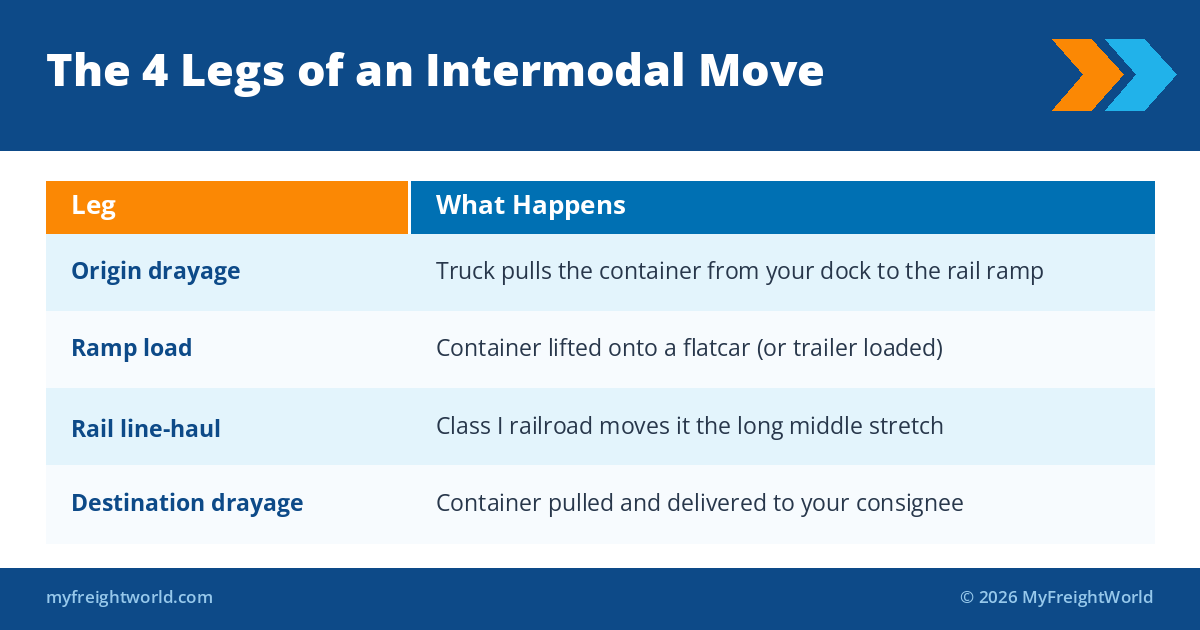
Every intermodal move follows the same four-leg pattern, whether the freight is going 600 miles or 2,000.
First, origin drayage: a local truck picks up the loaded container from your dock and hauls it to the rail ramp. Second, the container is lifted onto a flatcar, or in some cases the whole trailer is loaded directly. Third, the rail line-haul: a Class I railroad moves the container across its network for the long middle stretch, which is where the cost savings come from. Fourth, destination drayage: at the far ramp the container is pulled and a local truck delivers it to your consignee. The container stays sealed across all four legs. For a closer look at the truck legs specifically, see the drayage leg that connects your dock to the ramp.
Why shippers use intermodal
Intermodal is not just a cheaper truck. It has structural advantages that come from putting the long leg on rail.
Cost is the headline: on qualifying long lanes, intermodal typically runs 10 to 25 percent below full truckload, because rail moves a ton of freight far more cheaply per mile than a truck can. Rail also offers a capacity buffer when truck capacity tightens, so intermodal can keep your freight moving when the road market is hot. And because the container is sealed from origin to destination, your goods are handled far less than they would be in LTL, where freight is loaded and unloaded at terminals along the way. Fewer touches means lower damage rates.
Curious If Your Lane Fits?
Tell us your origin, destination, and freight, and MFW will show you whether intermodal saves you money.
Get an Intermodal QuoteWhen intermodal is the right call (and when it is not)
Intermodal is a strong fit for a specific freight profile, and a poor fit outside it. Knowing the line saves you from forcing the wrong mode.
It works best on lanes of 500 miles and longer, for non-urgent freight that can absorb a day or more of extra transit, and for stackable, non-hazmat commodities moving on consistent volume. It is the wrong choice for short hauls under 500 miles, where the two drayage legs erase the savings, for time-critical shipments that cannot wait on a rail schedule, and for freight that needs special handling mid-transit. When the lane favors the road, full truckload is the better tool, and our guide on intermodal vs truckload walks through the decision in detail.
Frequently Asked Questions
What is the difference between intermodal and multimodal shipping?
Both move freight across more than one mode. The difference is contractual: intermodal typically uses separate contracts for each leg, with each carrier responsible for its own segment, while multimodal uses a single contract with one operator responsible for the entire journey. A broker that manages an intermodal move as your single point of contact gives you multimodal-style simplicity over an intermodal shipment.
Is intermodal cheaper than truckload?
On lanes of roughly 500 miles or more, yes, usually 10 to 25 percent cheaper. The savings grow with distance. On shorter lanes the two drayage legs cancel out the advantage and truckload is generally cheaper and faster.
How much longer does intermodal take than a truck?
Typically a day or more, depending on the lane and the rail schedule, since rail departs ramps on set days and drayage adds time on each end. For non-urgent freight the tradeoff is usually worth the savings; for time-critical loads it often is not.
Does my freight get unloaded between rail and truck?
No. That is the defining feature of intermodal. Your goods are loaded once into a container that stays sealed from origin to destination. Only the container changes vehicles, which is why intermodal sees lower damage rates than LTL, where freight is handled at terminals.
How MFW handles intermodal for you
Intermodal has four legs and several parties, but you should only have to talk to one. MFW acts as your single point of contact across the whole move, dispatching drayage at origin, booking the rail leg with the right Class I carrier, tracking the container, and coordinating final delivery. You get the cost advantage of rail without assembling the pieces yourself.
Send us your lane and freight details and we will tell you whether intermodal is right for it, and what it costs.
Ready to Ship?
Let MFW manage your full intermodal move, drayage and rail, under one quote and one contact.
Get an Intermodal Quote