
Reviewed by the MyFreightWorld LTL team.
Scope: this guide covers U.S. domestic highway transportation under the Hazardous Materials Regulations (49 CFR Parts 171 to 180). Air, vessel and rail shipments, and shipments moving into Canada or Mexico, can carry different requirements.
You booked what looked like an ordinary LTL pallet. The driver backs into the dock, walks around the skid, sees a corrosive label on the drum, and looks at your shipping paper. There is no identification number on it. There is no emergency response telephone number. He does not take the freight.
Now you are paying a redelivery charge and your customer’s delivery date is gone. Documentation errors found in transit can also result in civil penalties, which are assessed case by case rather than at a standard amount (49 CFR 107.329).
Hazmat LTL shipping means moving materials the Department of Transportation regulates as hazardous, on a less-than-truckload network. The underlying federal rules are the same whether the freight moves LTL or truckload, but an LTL network creates additional handling, segregation and carrier-acceptance considerations because the freight shares trailers and terminals (49 CFR 177.848). That is the practical difference, and it is where most of the friction comes from. If you are new to the mode generally, start with our overview of LTL shipping.
This guide covers what makes a shipment regulated, the paperwork and marking requirements, placarding and who is responsible for it, the training and registration obligations shippers often miss, what hazmat LTL costs, and how carrier acceptance actually works.
Hazmat LTL Requirements at a Glance
This table is an orientation aid, not a compliance determination. Every line has exceptions that depend on the specific Hazardous Materials Table entry, quantity and packaging.
Free download: our one-page Hazmat LTL Quote-Readiness Checklist covers material identification, packaging, shipping papers, marking, lane considerations and internal obligations.
| Requirement | Primary responsible party | Where it lives | Common exceptions |
|---|---|---|---|
| Classification and description | Offeror / shipper | 49 CFR 172.101, 173.22 | Non-regulated materials; excepted quantities |
| Packaging selection and closure | Offeror / shipper | 49 CFR Part 173, Part 178 | Limited quantity; excepted quantity; consumer-level reliefs |
| Package marking and labeling | Offeror / shipper | 49 CFR 172.301, 172.400 | Limited quantity marking in place of full marking |
| Shipping paper and basic description | Offeror / shipper | 49 CFR 172.200, 172.202 | Limited quantity by highway generally relieved |
| Emergency response information and phone | Offeror / shipper | 49 CFR 172.600 to 172.606 | Materials listed in 172.600(d) |
| Providing required placards | Offeror / shipper | 49 CFR 172.506(a) | Vehicle already properly placarded |
| Affixing and displaying placards | Motor carrier | 49 CFR 172.506(b) | Below Table 2 threshold; domestic Class 9 |
| Hazmat employee training | Employer | 49 CFR 172.704 | None for non-hazmat functions |
| Shipping paper retention | Offeror and carrier | 49 CFR 172.201(e) | Two years hazmat, three years hazardous waste |
What Counts as Hazmat for an LTL Shipment
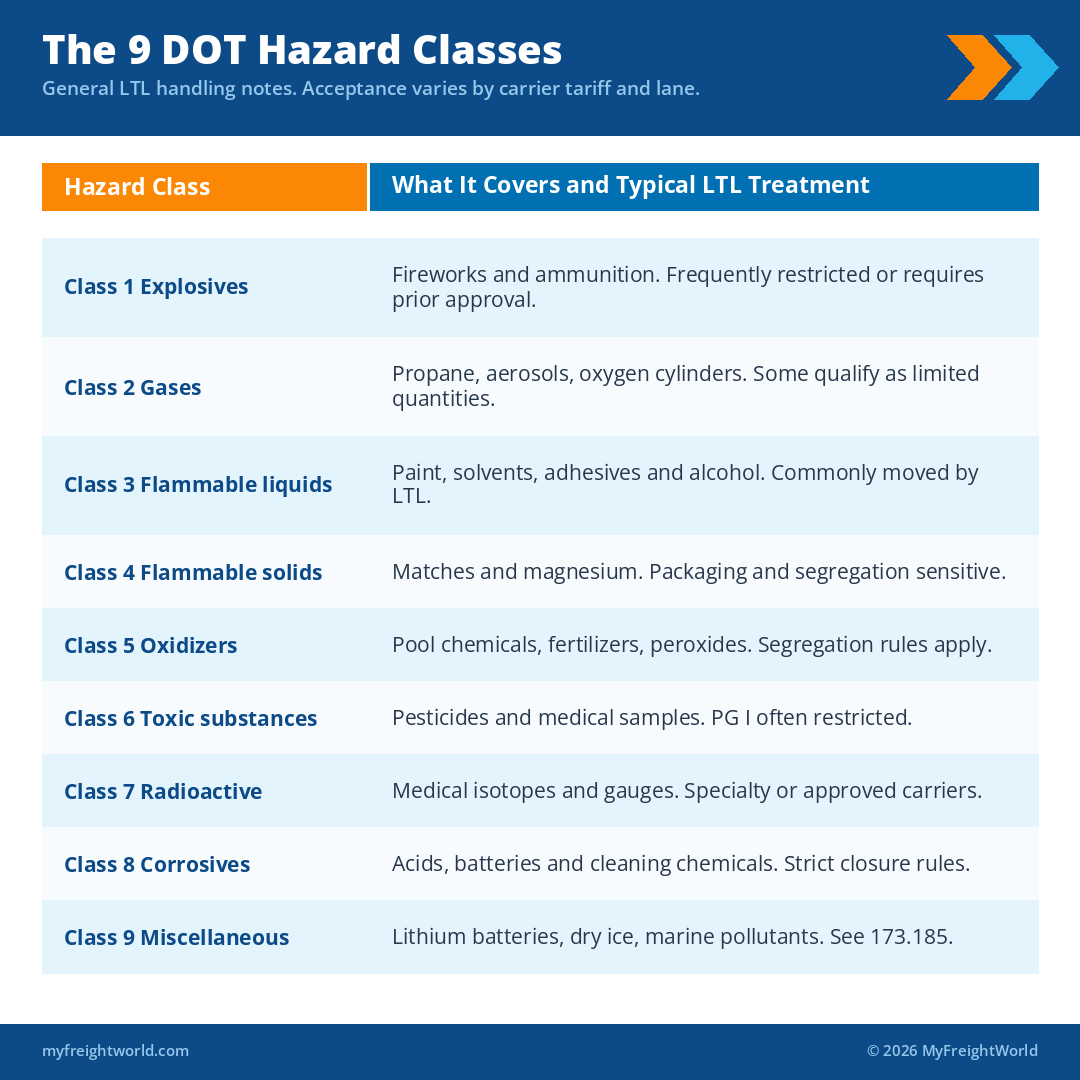
The DOT sorts hazardous materials into nine hazard classes. On our desk, Class 8 corrosives come up more than any other, though what you see depends heavily on your industry.
An OSHA pictogram is not a DOT classification
This trips people up constantly. A product can carry an OSHA hazard communication pictogram on its workplace label without being regulated the same way for transportation, and the reverse is also possible. OSHA hazard communication governs workplace safety. DOT classification governs transport. They use overlapping vocabulary and different rules. Transport classification has to be determined against the Hazardous Materials Table and the HMR (49 CFR 173.22), not inferred from a workplace label.
Limited quantities
Limited quantity is a real and useful relief, but eligibility is specific. It depends on the individual Hazardous Materials Table entry, the hazard class and division, the inner-packaging quantity limits and the mode of transport (49 CFR 173.156). Compliant highway limited quantities generally receive relief from shipping-paper and placarding requirements, subject to important exceptions, and still require the limited quantity marking.
Note that regulatory relief and commercial charges are separate questions. Whether a carrier applies a hazmat fee to a limited quantity shipment is governed by that carrier’s tariff or your contract, not by the HMR. Ask the carrier.
Excepted quantities
Excepted quantities are a distinct relief with their own eligibility and quantity limits set by regulation (49 CFR 173.4a). Eligibility is determined by the material and the amounts involved, not by the purpose of the shipment.
The ORM-D and consumer commodity designations are obsolete for new domestic ground shipments. The final day to offer ORM-D packages was December 31, 2020. If your packaging, work instructions or shipping software still reference ORM-D, that is a live compliance gap worth closing.
Shipping Papers and the Basic Description
When a shipping paper is required, the basic description has to appear in the prescribed sequence: identification number, proper shipping name, hazard class or division, and packing group if one is assigned (49 CFR 172.202). Packing groups are not assigned to every hazardous material, and some excepted shipments do not require a shipping paper at all.
A correct basic description reads:
UN1263, Paint, 3, II, 4 drums, 220 kg
ID number, then proper shipping name, then hazard class, then packing group, then package count and total quantity.
Additional descriptions are required in defined situations, including technical names for applicable n.o.s. entries, the RQ notation for reportable quantities, hazardous waste designations and marine pollutant notations (49 CFR 172.203). These sit alongside the basic description rather than replacing it.
The emergency response telephone number
The number must be monitored at all times while the shipment is in transit by a person knowledgeable about the material, or someone with immediate access to that person. The number cannot require a callback (49 CFR 172.604). A line that takes a message and returns the call later does not satisfy the requirement.
When you use a third-party emergency response provider, the shipping paper must identify the person who is contracted with that provider, by name, contract number or another approved unique identifier. Listing the provider’s number alone is not enough.
Emergency response information
Separate from the telephone number, emergency response information must accompany the shipment. A safety data sheet or an emergency response guide page can serve this purpose, but only when the document contains or cross-references all of the information required by 49 CFR 172.602. Do not assume an SDS automatically qualifies.
Safety data sheets are a starting point, not the authority
Section 14 of a safety data sheet is a useful starting point for transport information, but it is nonmandatory content under OSHA and may be incomplete, outdated, or written for a different mode or jurisdiction. A trained hazmat employee must verify the classification against the current HMR. The offeror retains responsibility for correct classification (49 CFR 173.22).
Certification and retention
The shipper’s certification is required when applicable to the shipment and the shipping paper, subject to HMR exceptions. Where it applies, it needs a signature. Blank certifications are a common cause of refusal at the dock.
On retention, shipping papers are generally kept for two years for hazardous materials and three years for hazardous waste, measured from the date the carrier accepts the shipment.
Marking, Labeling and Packaging
A fully regulated non-bulk package generally requires the proper shipping name and identification number, plus any applicable technical-name, orientation, overpack or other marks (49 CFR 172.301). Labeling refers to the diamond hazard labels applied to the package itself. Marking and labeling are distinct from placarding, which applies to the transport vehicle.
Performance-oriented UN or DOT specification packaging may be required depending on the Hazardous Materials Table entry, the quantity and the packaging authorization for that material. It is not universal, and the applicable section of Part 173 for your material governs.
Where specification packaging does apply, closure is an easy place to lose compliance. The packaging is certified as a complete system, including how it is closed. A certified drum closed without the specified gasket, or with the closure torqued outside the specified value, is no longer compliant even though the drum itself is correct. Manufacturers publish closure instructions, and following them is part of the certification.
The paperwork, though, is what actually stops shipments. When the bill of lading is wrong the freight sits, and our desk sees incorrect descriptions on the bill of lading cause more delays, late arrivals and added charges than any packaging defect does. Get the basic description, the emergency response telephone number and the shipper certification right on the document before the driver arrives, because a correction made at the dock costs you a day.
For general LTL preparation beyond the hazmat requirements, see our guide to LTL packaging requirements.
Placarding and Who Is Actually Responsible
Placarding is driven by the hazard class and the quantity offered, using two tables in the regulation (49 CFR 172.504).
| Table 1 materials | Table 2 materials | |
|---|---|---|
| Threshold | Placards required at any quantity | Generally required at 1,001 lbs or more aggregate gross weight of all Table 2 materials on the vehicle |
| Typical contents | Certain explosives, poison gas, some radioactive and other high-hazard entries | The majority of commonly shipped classes, including much of Class 3 and Class 8 |
| LTL relevance | Rarely accepted on general LTL networks | The usual case for LTL hazmat |
| Watch for | No quantity relief | Bulk packagings, Table 1 combinations and domestic Class 9 follow different rules |
Two points that are easy to get wrong. The 1,001 pound figure is an aggregate gross weight of Table 2 materials on the vehicle, not a per-shipment number, and it comes with exclusions and exceptions. And domestic Class 9 shipments generally do not require a Class 9 placard, although identification-number marking rules can still apply to bulk packagings.
Placarding is not purely the carrier’s job. Under 49 CFR 172.506(a), the offeror must provide the required placards to the motor carrier unless the vehicle is already properly placarded. The carrier is then responsible for ensuring placards are affixed and displayed before transport. If you have been assuming your carrier supplies the placards, verify it.
Training, Registration and Security Plans
These three obligations sit with the shipper and are easy to overlook, because none of them are triggered by a driver standing at your dock.
Hazmat employee training. Anyone who performs a function subject to the HMR is a hazmat employee and must receive general awareness, function-specific, safety and security awareness training, with recurrent training at least once every three years (49 CFR 172.704). This covers people who classify, package, mark, label, prepare shipping papers or load freight, not only drivers.
PHMSA registration. Certain shipment types and quantities trigger an annual registration requirement with PHMSA, along with a fee (49 CFR 107.601). Check whether what you ship falls within the categories listed.
Security plans. Shippers and carriers who offer or transport specified higher-risk hazardous materials must develop and adhere to a written security plan (49 CFR 172.800). Applicability is defined by material and quantity.
Segregation, Securement and Lithium Batteries
Because LTL freight shares a trailer, segregation matters in a way it does not on a dedicated load. The regulations prohibit loading certain materials together and require others to be separated (49 CFR 177.848). Packages also have to be secured against shifting under normal transportation conditions. In practice this is what drives a carrier to refuse a poorly built or unsecured hazmat skid even when the paperwork is perfect.
Lithium batteries deserve their own note. Calling them Class 9 is accurate but not useful on its own. Lithium cells and batteries are governed by an extensive and frequently updated set of provisions covering state of charge, cell and battery watt-hour or lithium-content thresholds, packaging, marking and whether the batteries ship alone, with equipment or in equipment (49 CFR 173.185). If you ship lithium batteries, read that section specifically rather than relying on general Class 9 guidance.
What Hazmat LTL Costs
Many LTL carriers apply a hazmat fee per shipment rather than per pound, which means the charge can weigh more heavily on smaller shipments in percentage terms. On our desk that fee commonly runs around $35 per shipment, though amounts and structures vary by carrier, tariff and contract, so check the applicable tariff or your contract rather than assuming a standard figure.
Consolidating small hazmat shipments into fewer, larger ones can reduce total fee exposure, but it is not automatically the right move. Larger quantities can change placarding thresholds, segregation requirements, handling and carrier acceptance. Compare consolidated LTL, volume LTL and truckload pricing only after confirming compatibility and checking the regulatory thresholds involved.
Freight classification
Freight classification for hazardous commodities follows the same NMFC rules as any other freight. Being hazardous does not by itself set your class. Confirm the correct NMFC item for your specific commodity rather than assuming the one you have always used still applies, particularly if the formulation has changed. Our guides to how LTL freight class is determined and NMFC codes cover the general mechanics.
The costs that are easy to miss
- Fewer carriers accepting your material on a given lane can mean less rate competition, with no line item explaining it
- Hazmat freight can move to and from plants, yards and job sites that trigger LTL accessorial charges such as limited access and liftgate
- A refusal at pickup can generate redelivery and storage charges, a missed appointment, and internal time to correct and rebook
Shipping regulated freight
Send us the proper shipping name, UN or NA number, hazards, packing group if assigned, quantity and packaging details, and we will help identify carriers and options for your lane.
Get a Hazmat LTL QuoteCarrier Acceptance and Lane Considerations
One rule catches shippers out regularly: hazmat freight generally cannot be booked on a guaranteed service. Carriers will usually decline to extend a delivery guarantee to hazardous materials, and some state plainly that a guarantee booked on a hazmat shipment will not be honored even if you pay for it. If a hazmat shipment is genuinely date critical, price it as a dedicated move instead. Our guide to expedited LTL shipping covers how that pricing works.
LTL carriers publish restricted and prohibited commodity lists, sometimes called a hazmat matrix, showing what they will handle and under what conditions. Review the applicable list before booking.
Acceptance is not determined by hazard class alone. The identification number, packing group, quantity, packaging and lane all matter. Classes such as Class 1 explosives, Class 6.1 Packing Group I materials and Class 7 radioactive materials are frequently restricted or subject to prior approval on general LTL networks, though some carriers accept portions of these under defined conditions. Check the current tariff rather than generalizing.
Terminal-level differences
A carrier can accept a material at the network level and still handle it differently through a specific origin or destination terminal, based on that terminal’s capabilities and the carrier’s own operating requirements. This is worth confirming at the time of quote rather than after the freight is tendered.
Routing and transit time
Many federal routing provisions apply to placarded quantities rather than to all hazardous materials (49 CFR Part 397). Where they apply, certain tunnels, bridges and designated routes are restricted, which can affect transit. Published LTL transit times assume standard routing, so allow margin where placarding is involved.
When to compare against truckload
There is no universal pallet count at which hazmat should stop moving LTL. The decision turns on weight, cube, dimensions, lane, accessorials, segregation compatibility and regulatory thresholds. A dedicated truckload shipment avoids cross-docking and mixed-commodity trailers, which can matter for some materials regardless of price. Our overview of comparing LTL carriers covers carrier selection more broadly.
Frequently Asked Questions
Is hazmat LTL shipping more expensive?
Yes. Most carriers add a hazmat fee per shipment rather than per pound, which on our desk commonly runs around $35, and hazmat freight also tends to carry tighter accessorial and acceptance rules. Because the fee is per shipment, it weighs more heavily on small shipments in percentage terms.
Does hazmat shipping take longer?
It can. Where placarding applies, federal routing provisions can restrict certain tunnels, bridges and designated routes, and hazmat freight may be handled differently at terminals. Published transit times assume standard routing, so allow margin.
Can hazmat freight be double stacked?
This is really two separate questions. The regulatory question is whether the packaging is authorized to be stacked, and that depends on the packaging type. IBCs and Large Packagings may display stacking-load information, while rules for ordinary non-bulk packagings are more nuanced. The commercial question is the carrier’s own pallet-stacking policy, which is separate and often more restrictive. Mark freight do not stack when stacking would compromise the packaging, and confirm the carrier’s policy.
Do I need a placard on my pallet?
Placards apply to the transport vehicle, not to your package. Your package requires marking and labeling. Under 49 CFR 172.506(a) the offeror must provide required placards to the carrier unless the vehicle is already properly placarded, and the carrier is responsible for affixing and displaying them.
Who is legally responsible if the paperwork is wrong?
Responsibility is allocated by function rather than to a single party. More than one offeror can exist on a shipment, and each person is responsible for the pre-transportation functions they perform or are required to perform under 49 CFR 171.2. Carriers retain their own applicable responsibilities. Practically, the party that classified and described the material carries that exposure.
Does my team need hazmat training?
If anyone performs a function subject to the HMR, including classifying, packaging, marking, labeling, preparing shipping papers or loading, they are a hazmat employee and require training under 49 CFR 172.704, with recurrent training at least every three years.
The Bottom Line on Hazmat LTL Shipping
Hazmat LTL shipping is not more legally demanding than truckload, but the shared-trailer environment adds handling, segregation and carrier-acceptance considerations that catch shippers out.
Three things are worth confirming before your next hazmat tender. Verify the classification against the current HMR rather than relying on a safety data sheet alone. Confirm your shipping paper carries the basic description in the required sequence with an emergency number that does not require a callback. And check the carrier’s current requirements for your material, packing group, quantity and lane before you book, not after.
This article is general educational information about U.S. domestic highway transportation, current as of September 2026. It is not compliance advice and does not address every requirement or exception. Shipment-specific classification and preparation must be completed by a trained hazmat employee against the current Hazardous Materials Regulations.
Hazmat LTL, handled
Tell us what you are shipping and where it is going. We will help you compare carriers and options for regulated freight on your lane.
Get a Quote