
Reviewed by the MyFreightWorld LTL team.
When a delivery date stops being flexible, most shippers start asking about expedited LTL. The first thing worth knowing is that there are two different products sitting behind that question, and they are priced nothing alike.
Standard LTL gives you an estimate. Guaranteed LTL puts a carrier’s money behind a date on that same network. Expedited takes the freight off the network entirely and moves it on a dedicated van or straight truck. Most of the confusion in this category, and most of the overpaying, comes from treating the last two as the same purchase.
This guide covers what each level actually commits to, how each one is priced, what our desk sees them cost, and what to send with the request so the quote comes back accurate the first time.
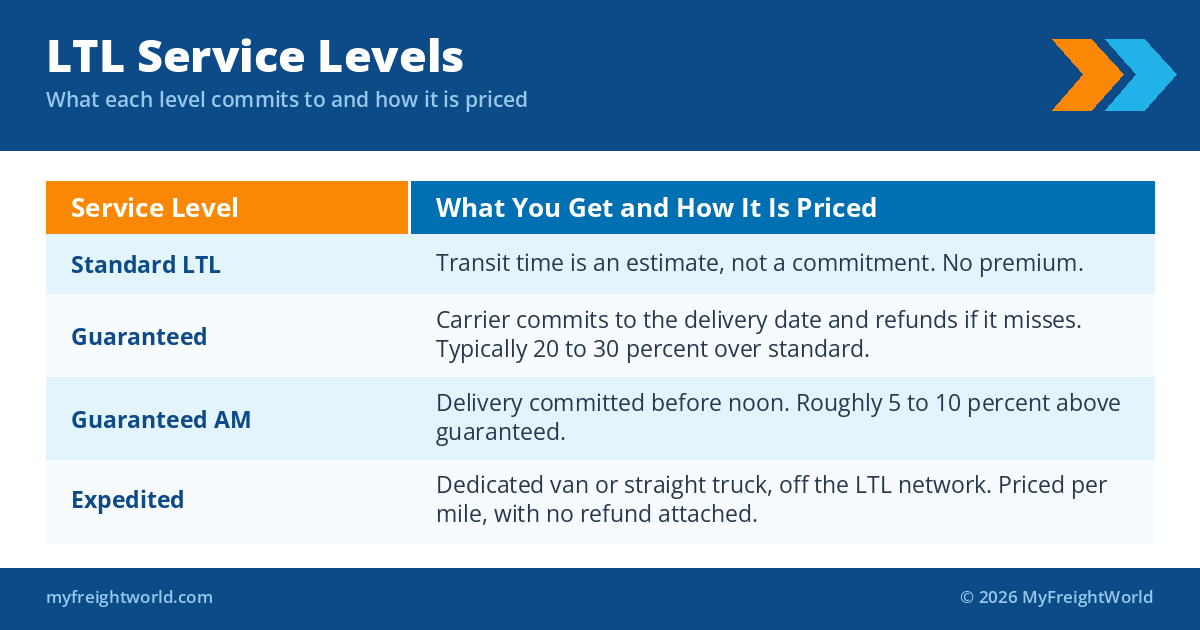
Guaranteed LTL is a date commitment on the standard network, typically 20 to 30 percent over a comparable standard rate, with roughly another 5 to 10 percent for a before noon delivery, and money back if the carrier misses. Expedited is a step above that: a dedicated sprinter van or straight truck priced per mile against the market rather than as a percentage of your LTL rate, with no refund attached, because it behaves like a small truckload move rather than like LTL.
Standard, Guaranteed and Expedited Are Three Different Purchases
Standard LTL transit times are estimates. Carriers publish service maps showing expected days in transit between points, and those estimates are usually reliable, but they are not promises. Nothing is owed to you if a shipment arrives a day later than the map suggested. For what to expect from standard service, see our guide to LTL transit times by distance.
Guaranteed LTL changes the terms without changing the freight’s path. The carrier commits to a delivery date and commits to a financial remedy if it misses that date. Your shipment still travels on the same equipment, through the same terminals, as standard freight. What you are paying for is priority handling inside that network plus a contractual date. Carriers use guaranteed service commercially, as a way to win freight from shippers who would otherwise shop on price alone.
Expedited sits a step above guaranteed, and it is a different kind of move rather than a stronger version of the same one. The freight comes off the LTL network. It goes on a dedicated sprinter van or straight truck, usually running direct from your dock to the consignee with no terminal handling in between. In practice it behaves much more like a small truckload or hot shot move than like LTL, and it is priced accordingly.
This is why comparing the three on transit days alone is misleading. Two carriers can quote the same number of days and be selling very different things, because one is estimating, one is committing, and one is not using the network at all.
What Guaranteed LTL Costs
Guaranteed service is priced as a percentage uplift on your base rate rather than as a flat fee. Based on what our LTL desk quotes, a date guarantee typically lands around 20 to 30 percent above a comparable standard rate. If you need the freight delivered before noon rather than by end of day, expect roughly another 5 to 10 percent on top of that.
The arithmetic is worth doing before you agree to it. Take a standard rate of $450 on a two pallet shipment. A date guarantee at the middle of that 20 to 30 percent range puts you near $560. Adding a before noon commitment at the middle of the 5 to 10 percent range puts you near $600. That is illustrative arithmetic on the midpoints rather than a quote, but it shows the shape of the decision: you are deciding whether the date is worth roughly $150 on this shipment, not whether it is worth an abstract percentage.
Because the premium is a percentage, anything that inflates your base rate inflates the premium with it. A LTL freight class error or an unflagged accessorial does not just cost you once, it costs you again on the uplift. Accurate class and measured dimensions are worth more on a guaranteed shipment than on a standard one. For the full picture on what sits inside a base rate, see what drives LTL shipping costs.
What Expedited LTL Costs
Expedited does not carry a standard upcharge, and that is the most common surprise for shippers who expect it to work the way guaranteed service does. There is no percentage to apply. Expedited is quoted per mile against what the market will bear that day, and it is not built off your LTL contract or your annual volume. Two shippers with very different LTL pricing can get the same expedited number on the same lane on the same morning.
What that means in practice is that expedited is usually not a modest step up from a guaranteed rate. On a lane where standard LTL is near $450 and guaranteed is near $560, a dedicated sprinter van commonly prices at or above double the standard rate once the mileage is run. Published market ranges for expedited work generally fall between roughly $1.50 and $2.50 per mile for a sprinter van and roughly $2.00 to $3.50 per mile for a straight truck, which puts a 400 mile sprinter run somewhere in the $600 to $1,000 band before accessorials. Treat those figures as market context rather than as a quote.
Four things move an expedited number more than anything else: the equipment the freight actually requires, the length of the haul, how far a truck has to run empty to reach your dock, and what the market looks like in the hour you ask. That last one is why an expedited price quoted on a Tuesday may not hold on Thursday, and why expedited quotes carry a much shorter shelf life than LTL rates do.
Need it there on a date?
Send us the lane and the deadline. We will price standard, guaranteed, AM guaranteed and expedited side by side so you can see what each level of commitment actually costs.
Get an LTL QuoteWhat a Guarantee Does Not Cover
A guarantee is a commercial commitment, not a physical one, and every program carries exclusions. Weather, natural disasters and other force majeure events are almost always carved out. So are delays that trace back to the shipper or the consignee, including a closed dock, a refused delivery, a missed appointment or an address correction.
If the carrier does miss, what you get back depends on the carrier. More of them now refund the full freight charge, but some refund only the guarantee premium itself. It is worth asking before you book, and worth choosing the carrier that refunds the whole bill, because that carrier is putting its own money behind the commitment rather than simply handing back your upcharge.
Hazmat is the other common exclusion. Carriers generally will not honor a guarantee on hazardous materials, and some state plainly that a guarantee booked on a hazmat shipment will not be paid out. If you are moving regulated freight against a deadline, price it as a dedicated move rather than expecting a guarantee to hold. Our guide to hazmat LTL shipping covers the acceptance rules in detail.
A guarantee is only as strong as the information it was priced on. If the dimensions or weight on the bill of lading do not match the freight, carriers can rerate the shipment and treat the guarantee as void. Paying a premium does not protect an inaccurate tender.
When to Buy Which
Guaranteed service is straightforward to justify when the cost of being late is larger than the uplift. A production line waiting on a component, an installation crew already booked, a retail chargeback for a missed delivery window, or a seasonal window that closes are all situations where 20 to 30 percent on one shipment is cheap insurance.
Expedited is the answer when no LTL service level, guaranteed included, actually meets the date. It is also the answer when the freight is small enough for a van or a straight truck and cannot take terminal handling, or when the window is measured in hours rather than days. You are buying a truck, so you should be comparing it against truck pricing rather than against your LTL rate.
Neither one is worth buying in three cases. If your own schedule already has buffer built in, you are paying to arrive early rather than on time. If the real constraint sits at your dock or your supplier’s dock rather than in transit, expediting the linehaul does not solve the problem. And if the shipment is large enough, a full truck can come in below an expedited van rate, so it is worth pricing both.
Why an Expedited Quote Takes Longer Than a Standard One
A standard LTL quote is largely a lookup. An expedited quote is an evaluation, because the options have to be compared against your date rather than simply returned. Our desk generally needs about twice as long to turn around an expedited quote as a standard one, and that time is spent finding the option that actually meets the requirement rather than the cheapest one that might.
You control most of that turnaround. Because expedited is priced on mileage rather than on a rate table, correct origin and destination ZIP codes matter even more here than they do on a standard shipment, and dimensions decide which equipment the freight will actually fit. Send both accurately and the evaluation is fast. Send a guess on either and the quote either comes back slowly or comes back wrong.
Measure the loaded pallet rather than trusting a supplier’s specification sheet, since stacking, wrap and any overhang all change the footprint the equipment has to accommodate.
How to Set Up the Shipment Correctly
Six things to have ready before you request the quote. Each one removes a reason for the rate to change after booking.
- Measure the loaded pallet at its actual widest and tallest point, including any overhang, and weigh it on a calibrated scale.
- Confirm both ZIP codes, and flag whether either end is residential or limited access before the quote is built.
- State the required delivery date and the time window, since before noon and by end of day are priced differently on guaranteed service.
- Ask what the guarantee actually remedies if the carrier misses, and get that answer in writing rather than assuming a full refund.
- Get every expected accessorial on the quote up front. On a guaranteed shipment they are marked up by the same percentage as the linehaul, and on an expedited move they are added on top of a per mile rate.
- Confirm the pickup cutoff time at your origin. A guarantee that starts a day late is not the guarantee you thought you bought.
Expedited LTL Against the Other Fast Options
Once you accept that expedited means buying a truck rather than upgrading a network shipment, the comparison set changes. These are the options worth pricing against each other when a date is firm.
| Option | Best when | Watch out for |
|---|---|---|
| Guaranteed LTL | One to six pallets on a date that is firm but still measured in days, and the freight can take normal terminal handling | The premium scales with your base rate, so class and accessorial errors compound |
| Expedited van or straight truck | No LTL service level meets the date, or the freight cannot take terminal handling | Priced per mile against the market, so the quote moves day to day and carries no refund if it runs late |
| Parcel or small package | Single cartons under roughly 150 pounds each | Cost per pound climbs quickly once you are stacking several cartons |
| Full truckload | Enough volume that a trailer is justified anyway | Availability on short notice in tight markets |
| Air freight | Very long distance against a very short window | Dimensional pricing and airport to door handoffs add cost and steps |
On anything more than a few pallets, price expedited and a truckload freight move against each other rather than assuming the smaller equipment is cheaper. A sprinter van has a low ceiling on both weight and cube, and once you pass it the straight truck and then the full trailer become the honest comparison.
Frequently Asked Questions
What is the difference between expedited LTL and guaranteed LTL?
Guaranteed LTL is a date commitment on the standard LTL network. The freight moves on the same equipment through the same terminals as everything else, and the carrier owes you money if it misses the date. Expedited is a step above that. The freight leaves the LTL network and moves on a dedicated sprinter van or straight truck, usually direct. They are different products at different prices, so it is worth being explicit about which one you are asking for.
How much more does guaranteed LTL cost than standard?
Our desk typically sees a date guarantee price at roughly 20 to 30 percent above a comparable standard LTL rate, with delivery before noon adding roughly another 5 to 10 percent. Because it is a percentage uplift rather than a flat fee, the dollar figure scales with your base rate.
How is expedited LTL priced?
Per mile, against the market on the day you ask. There is no standard percentage upcharge, and the rate is not built off your LTL contract or your volume. That is why expedited quotes are quoted fresh and expire quickly.
Does expedited freight move on different trucks?
Yes. Sprinter vans and straight trucks are the two most common pieces of equipment, and the move is usually direct rather than routed through terminals. This is the main practical difference between expedited and guaranteed service, where the freight stays on the standard network.
Do I get money back if an expedited shipment runs late?
Generally no. Expedited behaves like a truckload move, and truckload moves do not carry a delivery guarantee with a refund attached. The money back remedy belongs to guaranteed LTL service. If a financial remedy matters more to you than raw speed, guaranteed is the product that provides it.
Can hazmat freight be expedited or guaranteed?
Usually not. Carriers generally will not extend a guarantee to hazardous materials, and some will state outright that a guarantee booked on a hazmat shipment will not be honored. Regulated freight against a deadline is normally priced as a dedicated move instead.
How quickly can I get an expedited LTL quote?
Our desk generally needs about twice as long as a standard quote, because the options have to be evaluated against your date rather than looked up. Accurate ZIP codes and measured dimensions are what shorten that turnaround.
Is expedited cheaper than booking a truckload?
On small shipments over shorter distances, often yes, because a sprinter van costs less to run than a tractor trailer. As weight and cube climb, the gap closes and then reverses. Price both rather than assuming.
Getting the Date Without Overpaying for It
The practical takeaway is to name the product you actually need. If the date is firm but a day of normal transit still works, guaranteed service buys you a commitment and a remedy for a percentage you can calculate in advance, and tightening your base rate with accurate class, verified weight and measured dimensions shrinks that premium in absolute terms. If no network service meets the date, you are buying a truck, and the right comparison is against other trucks rather than against your LTL rate. For the wider context on modes and service levels, start with our complete guide to LTL shipping.
Price the deadline, not just the freight
Tell us the lane, the pallet dimensions and the date you need. We will show you standard, guaranteed, AM guaranteed and expedited together with the accessorials included.
Get an LTL Quote