

The real question about intermodal is not whether it is slower than a truck, because it usually is. The question is how much slower, and whether the extra time is worth the savings. Intermodal typically adds a day or more versus full truckload on the same lane, while cutting cost by 10 to 25 percent. Whether that trade works depends on your freight and your delivery windows.
This guide gives you realistic door-to-door timelines by major lane, explains how intermodal transit time is built, what can add days, and when the slower schedule is the right call. For the wider view of how the whole move works, start with our intermodal freight services overview.
Intermodal transit time is the sum of origin drayage, the rail line-haul, and destination drayage, with drayage adding 1 to 2 days on each end. Expect roughly a day or more longer than full truckload on the same lane, in exchange for 10 to 25 percent lower cost. It fits non-urgent, planned freight; time-critical loads should stay on the road.
How intermodal transit time is built
An intermodal schedule is not one number. It is the sum of several steps, and understanding them tells you where the time goes and which parts can slip.
It starts with origin drayage and the ramp cutoff: the container has to be pulled from your dock and delivered to the ramp before the train’s departure cutoff, which is not daily on every lane. Then the rail line-haul is the bulk of the clock, the days the container spends moving across the Class I network. At the far end, the container is pulled at the destination ramp and a final drayage leg delivers it to your consignee. Drayage on each end typically adds 1 to 2 days, which is why a 3-day rail move can be a 5 to 6 day door-to-door move. For more on the middle leg, see how the rail leg works.
Typical transit times by major lane
These are planning estimates for door-to-door intermodal transit, including drayage on both ends, compared with typical full truckload transit on the same lane. Actual times vary with ramp schedules and network conditions, so confirm specifics at booking.
| Lane | Rail Days | + Drayage | Door-to-Door |
|---|---|---|---|
| Chicago to Los Angeles | 5 to 7 | 2 to 4 | 7 to 11 |
| Chicago to Dallas | 2 to 3 | 2 to 4 | 4 to 7 |
| Atlanta to Chicago | 2 to 3 | 2 to 4 | 4 to 7 |
| Los Angeles to New York | 7 to 9 | 2 to 4 | 9 to 13 |
| Chicago to Seattle | 4 to 5 | 2 to 4 | 6 to 9 |
As a rule of thumb, intermodal runs a day or more behind a solo truck on these lanes, and the gap widens on the longest hauls where rail spends more days in transit.
What adds time to an intermodal move
Most intermodal delays are predictable if you know what to watch. A few variables account for nearly all of the schedule risk.
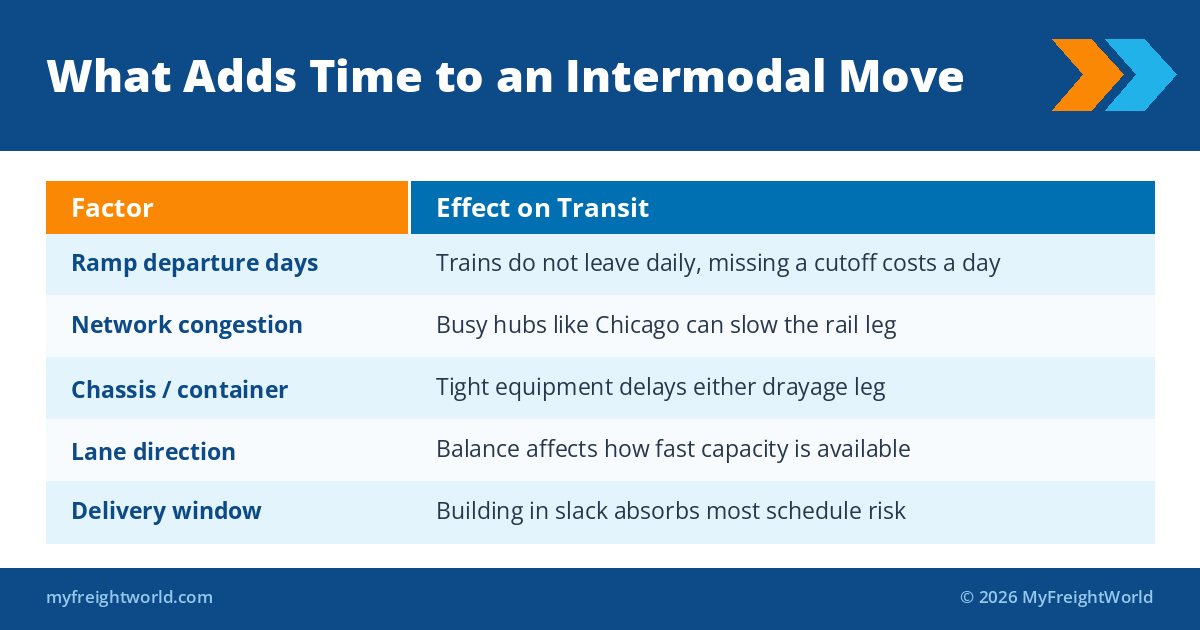
Ramp departure days and cutoffs matter most, because trains do not leave every ramp every day, and missing a cutoff can cost you a full day or more waiting for the next departure. Network congestion and weather can slow the rail leg, especially through busy hubs like Chicago. Chassis and container availability can delay either drayage leg if equipment is tight in that market. And lane direction and balance affect how quickly equipment and capacity are available. Building a little slack into your delivery window absorbs most of these.
Plan Your Lane Around Real Transit
MFW books the rail leg and both drayage legs to a realistic schedule, so your delivery window is built on facts, not guesses.
Get an Intermodal QuoteWhen the extra days are worth it
The slower schedule is a feature for some freight and a dealbreaker for others. The deciding factor is how flexible your delivery window is.
Intermodal makes sense for non-urgent freight, planned replenishment, and cost-sensitive shipments where saving 10 to 25 percent matters more than arriving a day sooner. It is the wrong tool for time-critical loads, tight appointment windows, or anything that cannot absorb a schedule slip, where full truckload is faster and more predictable. Our guide on intermodal vs truckload walks through the full decision.
Frequently Asked Questions
How much slower is intermodal than truckload?
Usually a day or more on the same lane, and the gap grows on the longest hauls. A coast-to-coast move that takes 5 to 6 days by truck can run 9 to 13 days door-to-door by intermodal once you include drayage on both ends and the rail schedule.
Why does drayage add so much time?
Because the container has to be trucked from your dock to the ramp before a departure cutoff, and trucked from the destination ramp to your consignee after it arrives. Each of those legs is a separate truck move that typically adds 1 to 2 days, and the origin leg has to hit the train’s cutoff or wait for the next departure.
Are intermodal transit times guaranteed?
No. The lane times shippers see are planning estimates, not guarantees, because rail schedules, ramp congestion, weather, and equipment availability all introduce variation. A broker books to a realistic schedule and builds in appropriate slack, but intermodal is best suited to freight that can absorb some flexibility.
Can I speed up an intermodal shipment?
Only at the margins. Catching an earlier ramp cutoff, choosing a lane with more frequent departures, and turning the container quickly on each end all help. If you consistently need the fastest possible transit, that is a sign the lane belongs on a truck rather than on rail.
MFW plans your lane around realistic transit
The fastest way to know your real intermodal transit is to have one party plan the whole move. MFW books the rail leg with the right Class I carrier and dispatches drayage on both ends, then gives you a realistic door-to-door window built on the actual ramp schedule for your lane, not a best-case guess. You ship with a date you can plan around.
Send us your lane and freight details and we will show you the transit, the cost, and the tradeoff against truckload.
Ready to Ship?
Get a realistic door-to-door intermodal transit time for your lane, drayage and rail included.
Get an Intermodal Quote