
Long-haul truckload pricing swings with fuel and capacity, and finding drivers for 1,500-mile runs gets harder every year. Intermodal rail transportation gives shippers another option: move the freight most of the way by train and use trucks only for the short legs on each end. For the right lanes, that combination lowers cost per mile and steadies capacity without changing how your freight is packed or loaded.
This guide explains how intermodal rail actually works, what drives the cost, where the transit-time tradeoff shows up, and how to tell whether a lane is a good fit. If you are weighing rail against over the road, start with our intermodal freight services overview, then use this article to go deeper on the rail leg itself.
Intermodal rail moves your container by train between rail ramps, with short truck drays on each end. It usually wins on cost and emissions for lanes over about 700 miles, in exchange for one to two extra days of transit. Lanes near rail ramps with steady volume are the best candidates.
How Intermodal Rail Transportation Works
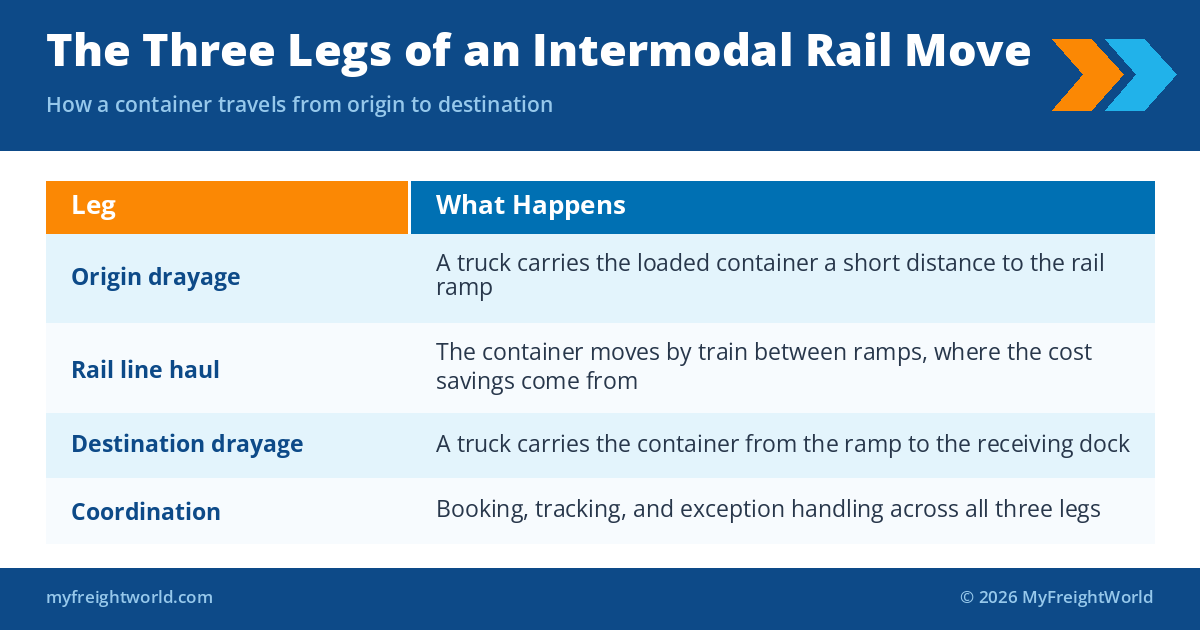
An intermodal rail move has three legs. At the origin, your freight is loaded into a container that is then trucked a short distance to a rail ramp. The container is lifted onto a railcar and travels by train to a ramp near the destination. From there, a truck carries it the final stretch to the receiving dock. The freight stays in the same container the entire time, which is what separates true intermodal from transloading, where goods are moved from one trailer to another.
The first and last legs are drayage to and from the ramp, short-haul trucking that bookends the move. The middle leg is the rail line haul, where the real cost savings come from. The container that rides the railcar is typically a 53-foot domestic box for inland US freight, or a 20-foot or 40-foot ISO container on import and export moves.
Because the container is never unpacked between origin and destination, handling damage risk drops and the work at each ramp is a single crane lift rather than unloading and reloading pallets. That is also why intermodal pairs so naturally with steady, palletized freight.
The Cost and Emissions Case for Rail
Rail’s advantage is cost per mile on the line haul. A single train moves hundreds of containers at once, and a train is dramatically more fuel-efficient than a truck on a per-ton basis. On long lanes, that efficiency shows up directly in the rate, which is why intermodal can come in well under a comparable full truckload quote once the distance is long enough to absorb the drayage on both ends.
The same efficiency lowers emissions per shipment, which matters for shippers reporting on sustainability goals. There is also a capacity benefit: when the truckload market tightens and spot rates spike, rail capacity tends to stay steadier, so intermodal can be a hedge against the swings that make long-haul budgeting difficult.
Transit Time and Reliability Tradeoffs
The tradeoff for those savings is time. On a comparable long lane, intermodal rail usually runs about one to two days longer than over-the-road truckload, because the move is paced by train schedules and ramp cutoffs rather than a single driver running straight through. The good news is that the transit is predictable once you know the ramp schedule, so it is reliable even if it is not the fastest mode.
Build the extra day or two into your delivery promises and inventory planning. Intermodal rail is dependable when you plan around train schedules and ramp cutoffs, but it is not the mode for a same-day or hot expedited shipment.
Compare Your Lanes
See whether rail beats over the road on your highest-volume lanes.
Get an Intermodal QuoteWhich Lanes Are a Good Fit for Rail
Three things make a lane a strong intermodal rail candidate: distance, ramp proximity, and consistency. Distance usually needs to be in the 700-mile-and-up range for the rail savings to outweigh the cost of two drayage legs. Both the origin and destination should be within a reasonable drive of a rail ramp. And the lane should carry steady, repeatable volume, since intermodal rewards shippers who can plan around a schedule. Kansas City is a strong intermodal hub, which makes it a natural fit for shippers in the MyFreightWorld network.
Lanes that are short, sit far from any ramp, or require guaranteed next-day delivery are usually better served by truckload. The fastest way to know is to model both options on your actual lanes, which is exactly what a broker does before recommending a mode.
Frequently Asked Questions
How long does intermodal rail shipping take?
On a comparable long lane, intermodal rail usually runs about one to two days longer than over-the-road truckload. Exact transit depends on the ramp schedules and the specific lane, but it is predictable once those are known.
Is intermodal rail cheaper than truckload?
On lanes over roughly 700 miles with steady volume, it usually is, because the rail line-haul cost per mile is lower than running a truck the whole way. Shorter lanes often favor truckload once you account for the drayage on both ends.
What size container is used for intermodal rail?
Most inland US domestic intermodal uses 53-foot containers. Import and export moves often use 20-foot and 40-foot ISO containers that originate at an ocean port.
Does my freight get unloaded during the rail move?
No. The freight stays in the same container from origin to destination. Only the container is transferred between truck and train, which reduces handling and damage risk.
Is intermodal rail more environmentally friendly than trucking?
Yes. Rail is far more fuel-efficient per ton-mile than over-the-road trucking, so shifting a long-haul lane to intermodal lowers emissions for that freight.
Is Intermodal Rail Right for Your Freight?
If you ship steady volume on long lanes near rail ramps and can absorb a day or two of transit, intermodal rail can cut your cost per mile and steady your capacity through tight markets. If your lanes are short or time-critical, truckload is likely the better call. The only way to know for certain is to model your specific lanes, comparing the rail line haul plus drayage against a straight truckload run. MyFreightWorld handles that analysis along with rail capacity, container access, and the drayage on both ends, all coordinated as one managed move.
Ready to Ship Smarter?
Get an intermodal shipping quote and see how rail compares on your lanes.
Get an Intermodal Quote