

When your LTL shipping invoice comes in higher than the quote, accessorial charges are almost always the reason. These are fees added to your base linehaul rate when your shipment requires services beyond standard dock-to-dock pickup and delivery, and they can add 15-40% to what you expected to pay if you did not account for them before booking.
The frustrating part is that most accessorial charges are completely predictable. A liftgate is needed when there is no loading dock. A residential delivery fee applies when the destination is a home or home-based business. Reclassification fees happen when the freight class is wrong. None of these are surprises if you walk through your shipment requirements before the quote is submitted.
This guide covers all 15 of the most common LTL accessorial charges, what triggers each one, typical cost ranges, and how to identify your exposure before booking so your quote is the rate you actually pay.
Accessorial charges are fees added to your LTL invoice when a shipment requires services beyond standard dock-to-dock pickup and delivery. They are the most common reason a final invoice comes in higher than the original quote. Most are completely avoidable if you identify your requirements before booking.
What Are LTL Accessorial Charges?
Accessorial charges are fees that LTL carriers add to a base linehaul rate for services, conditions, or circumstances that go beyond a standard commercial dock-to-dock shipment. The base rate covers the linehaul movement of your freight from one terminal to another. Everything else, any additional service, location type, or equipment requirement, is an accessorial.
Carriers price accessorials separately because they represent real additional costs: extra equipment, extra labor, scheduling overhead, extended driver time, or added liability. A liftgate truck costs more to operate than a standard trailer. A residential delivery takes longer and requires the driver to navigate non-commercial environments. A detention clock runs because someone is not ready to load or unload on time.
The key issue for shippers is not that accessorials exist. It is that they are often discovered on the final invoice rather than declared at the time of booking. A quote that does not include all applicable accessorials is not an accurate quote. It is just the first number you will see before the real bill arrives.
The 15 Most Common LTL Accessorial Fees
The table below covers the accessorial charges you are most likely to encounter on LTL shipments, when each one applies, and the typical cost range. Actual fees vary by carrier and tariff structure.
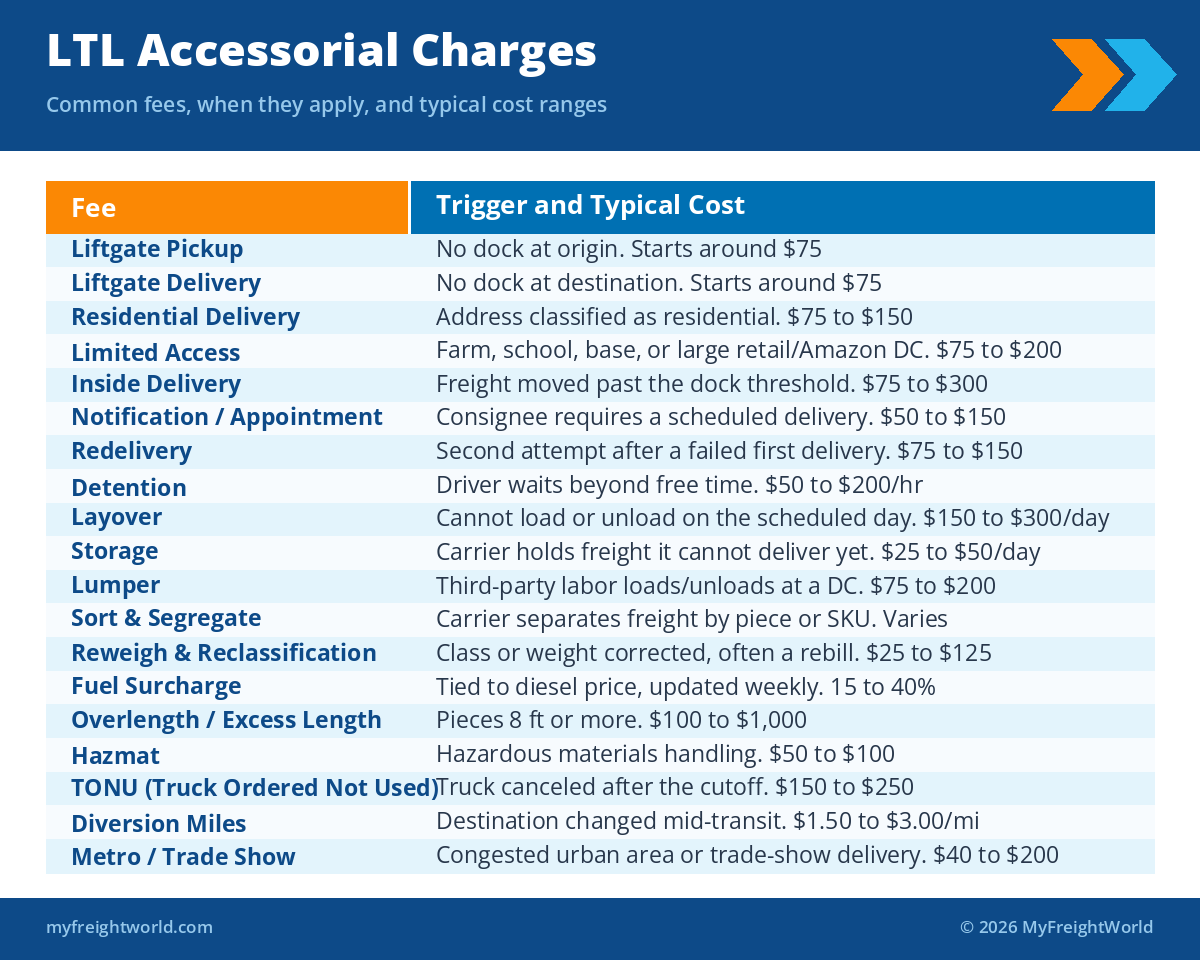
Cost ranges above reflect typical market rates as of 2026. Always confirm current accessorial pricing when requesting a quote, as fees vary by carrier and can change. Two trends worth flagging for 2026: excessive length fees have risen sharply over the past two to three years, with some carriers now charging $150 to $1,000 on shipments with pieces exceeding standard length thresholds. Limited access delivery is the other charge worth planning for, and it typically runs $75 to $150. In our LTL team’s experience the deliveries that surprise shippers are not the remote or unusual sites people expect. They are ordinary businesses in major metro areas where a truck cannot physically reach the building to unload. For the full picture on how these charges combine with your base rate and freight class multiplier, see our guide to total LTL shipping cost.
How to Avoid Unexpected LTL Surcharges
The most effective way to eliminate surprise accessorial charges is to complete a pre-booking checklist before submitting your shipment details. The 10 questions below cover the most common triggers. If you can answer all of them before requesting a quote, your rate will be accurate.
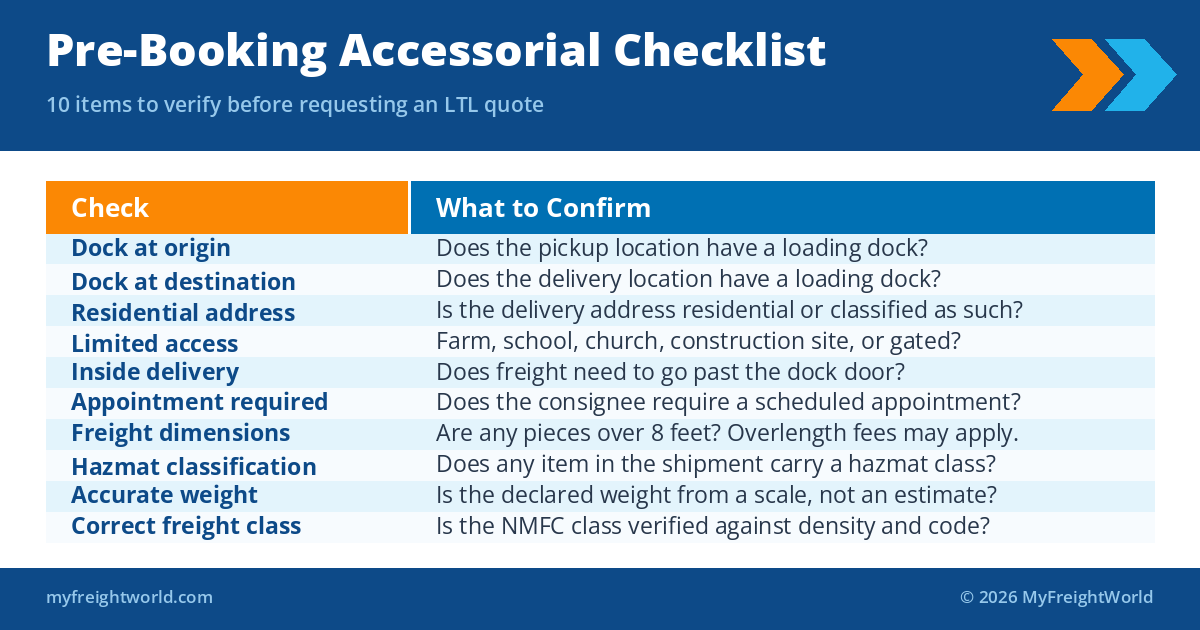
Walking through this checklist takes two minutes and consistently prevents the most common accessorial errors: undeclared liftgates, missed residential flags, unverified freight class, and dimensions that were estimated rather than measured. Any one of those can add $50-$150 to your invoice.
One additional step worth taking: verify with the consignee directly whether an appointment is required before the carrier attempts delivery. Many shippers assume standard delivery is fine, only to find out the receiving location requires advance scheduling, triggering an appointment fee and a potential redelivery charge if the first attempt fails.
How to Reduce Recurring Accessorial Costs
Declaring services up front stops the surprises. The fees that keep hurting shippers are the recurring ones tied to how freight actually moves, like detention, layover, and lumper charges. Those you reduce with process, not paperwork.
- Validate shipment details before pickup. Confirm the BOL, weight, dimensions, and freight class are right, and flag any special handling. A TMS that checks this automatically heads off reweighs and reclass fees before they happen.
- Streamline loading and unloading. Schedule pickup and delivery appointments, have freight staged and ready when the truck arrives, and staff the dock so you do not run the detention clock.
- Negotiate free time into your contracts. Build adequate detention free time into carrier agreements so normal dock variability does not trigger a fee on every load.
- Run carrier scorecards. Track on-time performance and how often each carrier hits you with detention, layover, or redelivery fees, then move volume to the carriers who cost you the least in accessorials.
- Use real-time visibility. GPS tracking and automated alerts let you catch a delay while you can still act on it, instead of finding it on the invoice.
Detention adds up faster than most shippers expect. Carriers typically allow about two hours of free time, then bill by the hour. Across just five shipments, three hours of detention each can pass $2,500. If you move 50 loads a month and each takes a $100 detention hit, that is $5,000 a month in avoidable cost.
More accessorial fees to know
| Fee | Typical range | Trigger |
|---|---|---|
| Layover | $150 to $300 per day | Truck cannot load or unload on the scheduled day |
| After-hour delivery | $75 to $150 | Delivery outside normal business hours |
| Truck Ordered Not Used (TONU) | $150 to $250 | Truck canceled after the cutoff |
| Diversion miles | $1.50 to $3.00 per mile | Destination changed mid-transit |
| Storage | $25 to $50 per day | Carrier holds freight it cannot deliver yet |
| Lumper | $75 to $200 | Third-party labor loads or unloads at a DC |
| Hazardous materials | $50 to $100 | Hazmat handling and paperwork |
| Metro pickup or delivery | $50 to $100 | Congested urban area |
| Trade show | $40 to $200 | Pickup or delivery to a trade show or advance warehouse |
Get a quote and we will pre-screen your lanes for the accessorials that keep recurring, then build a plan to reduce them.
How Accessorial Charges Affect Your LTL Rate
To illustrate how quickly accessorials accumulate, here is a real-world example of a single shipment where several fees applied that were not declared at booking.
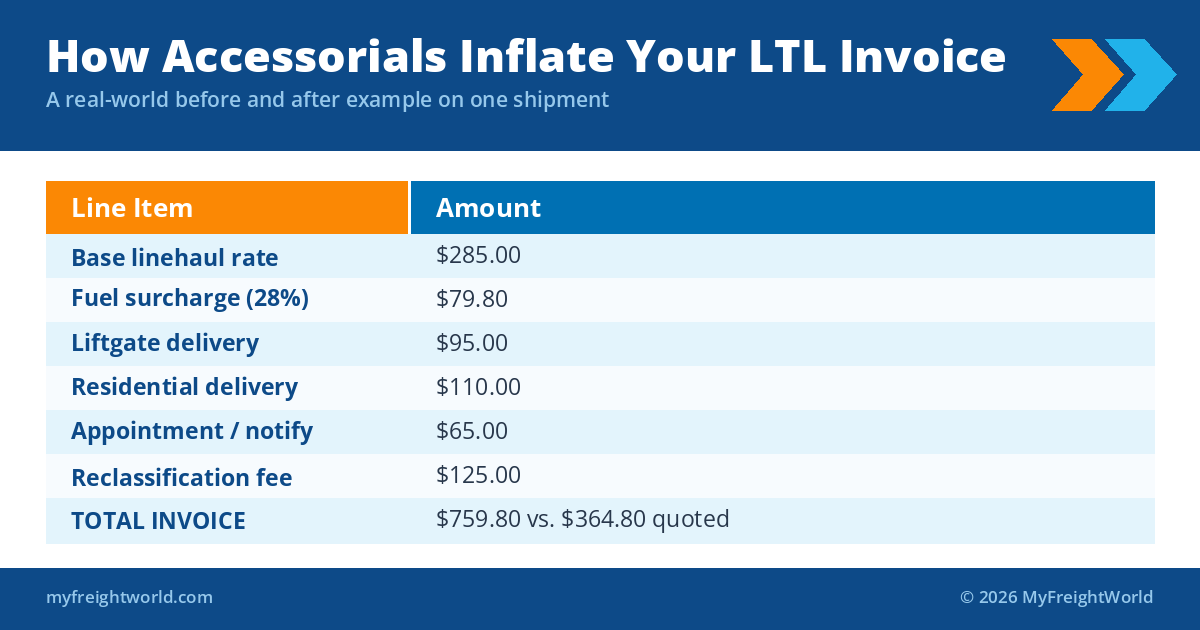
In this example, the shipper booked based on a quoted rate of $364.80, covering only the base linehaul and fuel surcharge. The actual invoice came in at $759.80 because the delivery location had no dock (liftgate), was a home business (residential), required a scheduled appointment, and the freight class was inspected and corrected at the terminal. Every one of those charges was avoidable with a proper pre-booking review.
The reclassification and re-weigh fees alone added $125 to this invoice. That is one of the most preventable accessorial charges on any shipment: verify your freight class before you book.
Working with a Freight Broker to Minimize Accessorial Fees
One of the practical benefits of working with a freight broker is that an experienced broker pre-screens your shipment details for accessorial exposure before the quote goes out. Rather than discovering fees on the back end, you address them on the front end, which keeps the quoted rate close to the final invoice.
MyFreightWorld reviews every shipment before booking: dock availability, address classification, freight class verification, dimension accuracy, and any special handling or appointment requirements. The goal is a quote you can rely on, not a starting number that grows through the billing process.
For shippers managing recurring LTL across multiple lanes, a broker relationship also provides consistency: the same checklist applied to every shipment, the same carrier relationships for exception management, and a single point of contact for tracking and claims support. For more on when a broker adds the most value, see the complete LTL shipping guide.
No Surprise Fees
MFW pre-reviews your shipment details to flag accessorial exposure before you book. Get a transparent quote.
Get a Transparent LTL QuoteFrequently Asked Questions: LTL Accessorial Charges
Are accessorial charges negotiable?
Some accessorials have limited negotiability through carrier contracts, particularly for high-volume shippers with established carrier relationships. Standard fees like liftgate, residential delivery, and fuel surcharge are generally fixed by tariff. The better approach for most shippers is not negotiating fees down after the fact but eliminating exposure upfront by declaring all applicable services at the time of booking.
What is a liftgate fee and when do I need one?
A liftgate fee is charged when the carrier needs to use a hydraulic platform on the back of the truck to raise or lower freight to ground level. You need a liftgate at pickup if the origin location has no loading dock, and at delivery if the destination has no loading dock. Both can apply on the same shipment, triggering two separate liftgate charges. Liftgate fees typically start around $75 per occurrence, though the amount can vary by carrier and shipment weight. Always confirm dock availability at both ends before booking.
How do I know what accessorials to expect on my shipment?
Work through the pre-booking checklist above before requesting a quote: confirm dock availability at origin and destination, verify the address classification (residential vs. commercial), check whether the consignee requires an appointment, measure your freight dimensions accurately, and verify your freight class against your actual NMFC code and density. Answering those questions before you book is the most reliable way to make sure your quote reflects your actual invoice.
What is the fuel surcharge and why does it change?
The fuel surcharge (FSC) is a percentage added to your linehaul rate to offset carrier fuel costs. It is tied to the national average diesel price, which fluctuates weekly. Most carriers publish their current FSC on their websites or through their tariff. The FSC varies by carrier, each carrier sets its own schedule tied to the EIA weekly diesel price index, so the rate differs across carriers even on the same lane. Always request the current FSC rate when comparing quotes, as a lower base rate with a higher FSC can end up more expensive than the alternative.
Know Your Accessorials Before You Book
Accessorial charges are not arbitrary fees. They represent real services and real costs, and they apply to a predictable set of circumstances. The shippers who consistently pay close to their quoted rate are the ones who identify those circumstances before the shipment moves, not after.
The 10-item pre-booking checklist, the 15-fee reference table, and the real-world invoice example above give you everything you need to approach your next LTL shipment with accurate numbers. If you are unsure about any of your shipment details, that is exactly when a freight broker adds the most value.
For a broader view of everything that drives your LTL rate, including freight class, weight, lane, and carrier selection, see the complete LTL shipping guide.
Ready to Ship?
Get a quote from MyFreightWorld. We identify accessorial exposure upfront so your rate is accurate before the shipment moves.
Get an LTL Quote — MyFreightWorld