
Dry van is the default trailer for most truckload freight. It is the familiar enclosed box trailer you see on every highway, and it carries everything from packaged food and retail goods to industrial parts and consumer electronics. If your freight is palletized, boxed, and does not need temperature control or open deck access, it almost certainly moves in a dry van.
This guide covers what dry van shipping is, what it carries, its capacity and specs, what drives the cost, and when another trailer type fits better. For the full mode overview, start at our truckload freight hub.
Dry van shipping moves enclosed, palletized freight in a standard 48 or 53 foot trailer. It is the most common and usually the most economical truckload option, carrying up to about 45,000 pounds and 26 pallets. Choose another trailer only when freight needs temperature control or will not fit inside a van.
What Is Dry Van Shipping?
A dry van is a fully enclosed trailer with a roof, walls, and rear doors. It protects freight from weather and theft and is loaded by forklift or pallet jack through the rear. Because it is the most common equipment on the road, dry van capacity is the easiest to source and usually the most competitively priced truckload option.
What Dry Vans Carry
Dry van handles any freight that is stable at ambient temperature and fits inside an enclosed trailer: packaged and canned food, retail and consumer goods, paper products, building materials that do not need open deck, machinery parts, and palletized industrial supplies. It is not used for perishables that need refrigeration or for loads that exceed the trailer’s interior dimensions.
Dry Van Capacity and Specs
Knowing the limits up front keeps a load from being rejected or re quoted at the dock.
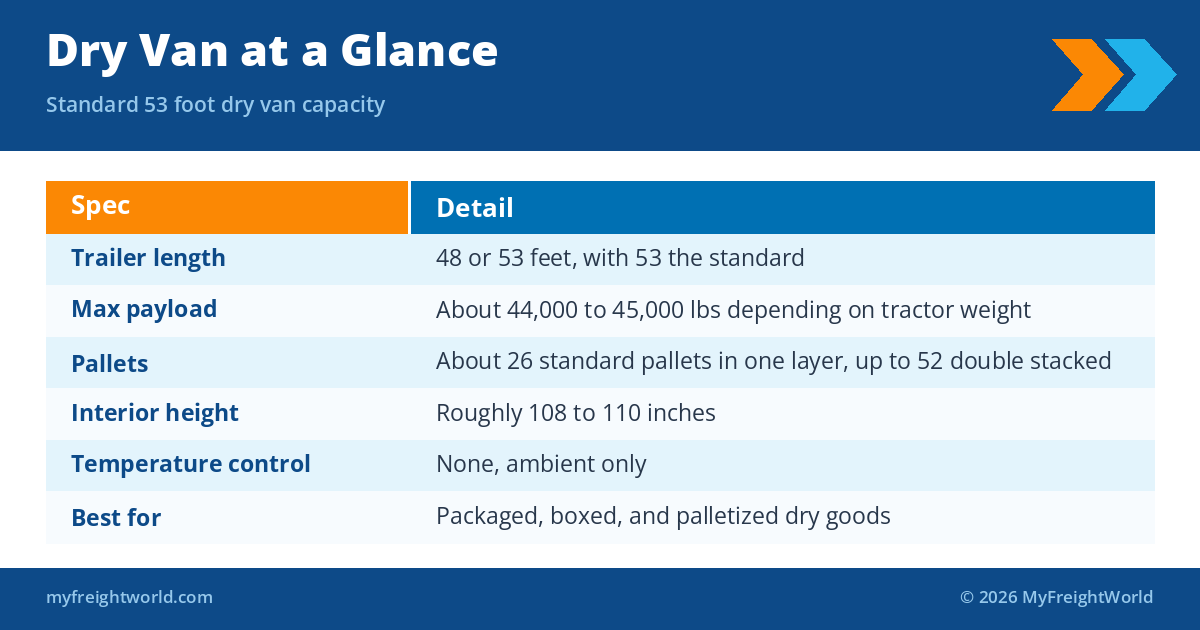
Most shippers hit the weight limit of about 45,000 pounds before they run out of floor space, especially with dense freight. If your pallets can be double stacked safely, you can fit far more in the same trailer.
Dry Van vs Other Equipment
Reach for a different trailer when dry van does not fit the freight. Temperature sensitive loads need a refrigerated trailer. Oversized or open deck freight needs a flatbed. And a shipment too big for LTL but too small to fill a van may be a better fit for partial truckload. When the freight is standard, dry van is almost always the most cost effective call.
What Dry Van Shipping Costs
Dry van is priced per mile like any truckload move, with a fuel surcharge and any accessorials on top. Because dry van capacity is plentiful, base rates are usually lower than specialized equipment. Lane balance, weight, and current capacity still move the number. See our guide to full truckload rates for the full breakdown.
Need dry van capacity?
Send your lane, weight, and pallet count. We match vetted dry van carriers and competitive rates, usually the same day.
Request an FTL QuoteFrequently Asked Questions
How much weight can a dry van carry?
A standard 53 foot dry van carries about 44,000 to 45,000 pounds of payload, depending on the weight of the tractor and trailer and legal axle limits. Dense freight often reaches the weight cap before filling the space.
How many pallets fit in a dry van?
A 53 foot dry van holds about 26 standard 48 by 40 inch pallets in a single layer, or up to 52 if they can be safely double stacked.
What is the difference between a dry van and a reefer?
A dry van is an unrefrigerated enclosed trailer for ambient freight. A reefer is a refrigerated trailer with a temperature control unit for perishable or temperature sensitive loads. Reefer capacity costs more.
Is dry van cheaper than flatbed or reefer?
Usually yes. Dry van equipment is the most plentiful, so base rates are typically lower than flatbed or refrigerated capacity on the same lane.
Move Your Dry Van Freight With MFW
Dry van is the workhorse of truckload shipping, and matching the right carrier to your lane keeps it economical and reliable. MyFreightWorld sources vetted dry van capacity nationwide. Explore the truckload freight hub or request a quote below.
Ready to ship dry van?
Tell us your freight and lane and we will return vetted carrier options with competitive pricing.
Request an FTL Quote