

Most LTL shipping problems are preventable. Wrong freight class, missing BOL information, poor packaging, and last-minute booking are the four mistakes that generate the majority of delays, reweigh fees, and damage claims. This guide walks through the practical steps that keep your LTL freight moving on time and on budget.
These tips apply whether you are booking your first LTL shipment or you have been shipping freight for years. One piece of market context worth knowing in 2026: we are currently in a carrier’s market, meaning carriers hold more pricing leverage than shippers. That makes rate discipline, knowing your class, declaring accessorials accurately, and working through a broker with pooled volume, more important than ever. Even experienced shippers pick up habits that cost them money without realizing it.
The biggest LTL cost drivers are preventable: wrong freight class, under-declared weight, inadequate packaging, and missing BOL data. Getting these right before pickup eliminates the most common fees and delays. A freight broker can catch issues before they hit your invoice.
Common LTL Mistakes and How to Fix Them
Here are the errors that most often cost shippers money, time, or both, along with exactly how to avoid them:
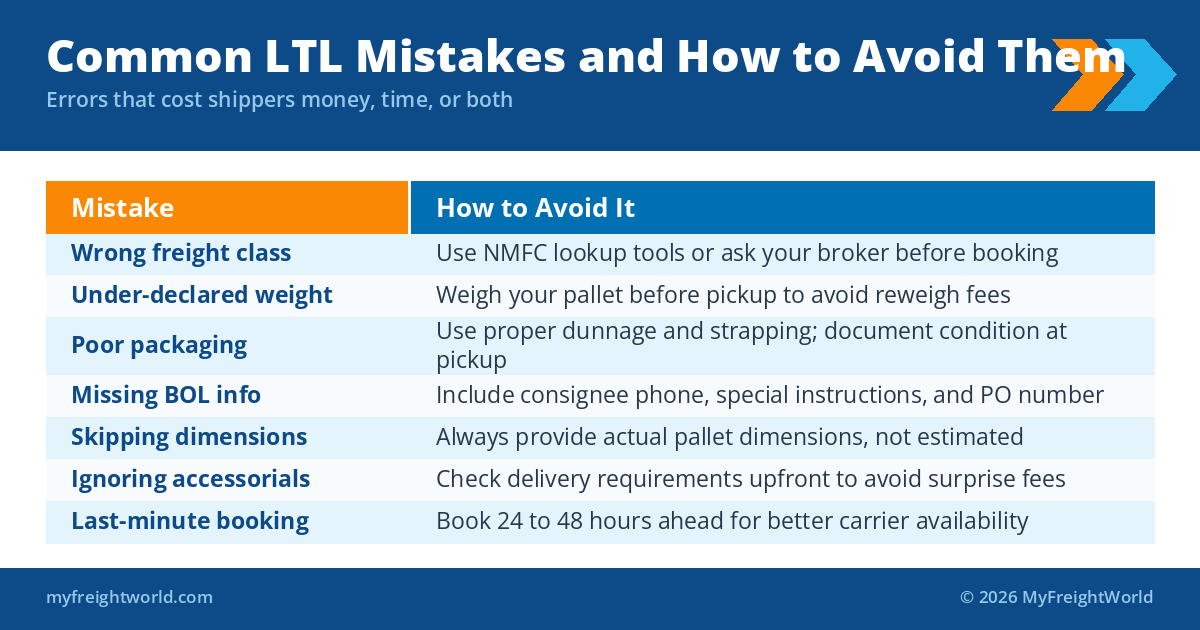
Tip 1: Get Freight Class Right Before You Book
Freight class is the single biggest lever in LTL pricing. Under-classify your freight and you will receive a reclassification notice and a higher invoice after delivery. Over-classify it and you are paying more than you should. The NMFC (National Motor Freight Classification) code for your specific product determines the correct class, and it is worth looking it up or asking your broker before every shipment if you ship diverse products.
Density-based classes add another layer. For some commodity types, the carrier calculates class from your shipment’s actual density (weight divided by cubic feet). If your dimensions are inaccurate, your density calculation is wrong, and so is your rate. Always provide precise pallet dimensions: length, width, and stacked height including the pallet itself. See our full breakdown of NMFC codes and freight class if you want to go deeper on classification.
Tip 2: Weigh Your Pallets Before Pickup
LTL carriers perform random reweighs at terminals. If the actual weight of your shipment exceeds the declared weight by more than a small tolerance, they will issue a weight correction notice and add the difference to your invoice, often at a higher class rate. That correction plus the adjustment fee can significantly inflate your cost.
The fix is simple: put every pallet on a floor scale before pickup. Industrial floor scales are inexpensive and pay for themselves quickly. If you share a dock or use a third-party warehouse, confirm that they have a scale and use it. Stating the actual weight is always cheaper than getting a reweigh after the fact.
Tip 3: Package Freight for the LTL Environment
LTL freight does not ride in a dedicated truck from door to door. It gets loaded and unloaded multiple times at relay terminals, often alongside other shippers’ freight, by forklift. Packaging that would survive a parcel carrier will frequently not survive LTL handling. Pallets need to be stable with freight that does not overhang the edges, wrapped with stretch film that goes all the way to the base of the pallet, and secured with strapping if the load is tall or heavy.
Document the condition of your freight before pickup with dated photos. If a damage claim arises, those photos are evidence that the freight left in good condition. Carriers are less willing to pay claims on freight that arrived without condition documentation. For detailed guidance, see our article on LTL packaging requirements.
Tip 4: Complete the BOL Before Pickup
The bill of lading is the legal contract between you and the carrier. Missing or incorrect BOL information is one of the most common causes of delivery delays and billing disputes. At minimum, your BOL should include: shipper name and full address, consignee name and full address with phone number, piece count, weight, freight class, and any special handling instructions.
If the delivery is to a residence, limited access location, or requires an appointment, note it on the BOL. Carriers charge for these services as accessorials, and they charge more when the requirement is discovered at delivery rather than at booking. Getting it on the BOL upfront prevents the surprise fee and gives the carrier time to plan the delivery correctly.
Tip 5: Check Accessorial Requirements Before You Quote
Accessorial charges are fees for services beyond standard dock-to-dock commercial delivery. Common ones include liftgate at pickup or delivery, inside delivery, residential delivery, limited access delivery, and notification or appointment fees. These are legitimate charges, but they can add $50 to $250 or more per shipment if you do not account for them at booking.
Before you quote a shipment, ask the consignee: is there a loading dock? Is this a residential address? Will anyone be available to unload, or do you need a liftgate? Does the delivery require an appointment? Answering those four questions before booking eliminates most accessorial surprises. See the full breakdown in our guide to LTL accessorial charges.
Tip 6: Book at Least 24 to 48 Hours Out
Same-day and next-day LTL pickups are possible, but carrier availability is not guaranteed and spot rates on short notice are typically higher. Booking 24 to 48 hours ahead gives the carrier time to schedule the pickup, assign the correct equipment, and slot your freight on the outbound load for your destination region.
Last-minute bookings also leave no time to correct BOL errors or packaging issues before the driver arrives. If something is wrong and you discover it when the truck shows up, the shipment may get rejected or delayed until it is corrected.
LTL SHIPPING MADE EASIER
MyFreightWorld handles freight class lookup, BOL preparation, and carrier selection so your shipments go out right the first time.
Get a Free QuoteFrequently Asked Questions
What is the most common cause of LTL shipping cost increases after delivery?
Freight class reclassification and weight corrections are the two most common post-delivery charge adjustments. Both are preventable by accurately declaring freight class and weighing pallets before pickup.
How can I reduce LTL shipping costs?
The biggest cost levers are accurate freight class, correct weight declaration, minimizing accessorial requirements, and using a broker with contracted carrier rates. Volume consolidation, where possible, also reduces per-unit shipping cost.
What information is required on an LTL bill of lading?
At minimum: shipper name and address, consignee name, address, and phone number, number of pieces, weight, and freight class. Include any special handling requirements such as liftgate, residential, or appointment delivery. Missing any of these is a common source of delays and billing disputes.
How should I package LTL freight to prevent damage?
Palletize all freight, stretch wrap to the base of the pallet, secure tall or heavy loads with strapping, and ensure no overhang beyond pallet edges. Document the condition at pickup with photos. See our full LTL packaging requirements guide for detailed standards.
Does using a freight broker reduce LTL costs?
For most small-to-mid-volume shippers, yes. Brokers have contracted carrier rates that are typically lower than direct spot rates, and they catch class and packaging issues before they become invoice adjustments.
Small Changes, Big Cost Impact
The difference between a smooth LTL program and a costly one often comes down to a few consistent habits: accurate class, correct weight, solid packaging, and complete BOL data. None of these require special tools or expertise. They just require attention before the freight goes out the door.
If you are regularly seeing unexpected charges or delays, a freight broker can audit your shipping data and identify where the problems are coming from. Learn more about what drives LTL shipping costs or get a quote and let us show you what a clean process looks like. For a full overview of how the LTL network works, see our LTL shipping guide.
SHIP LTL WITHOUT THE HEADACHES
MyFreightWorld helps shippers get freight class, packaging, and BOL right the first time, every time.
Get a Free Quote